The Chase, Ken Takakura, Ryoko Nakano, Odaiba, and Cessna 177RG
The film star Ken Takakura passed away at the end of last year. To commemorate this symbolic figure of the Showa era, many places have recently been showing the old movies he starred in.
That day, I picked up two complimentary tickets from the company and went to a small cinema in Odaiba to watch:
Pursuit / Kimi yo Fundo no Kawa o Watare / You Are the
 and
The Proof of the Wild / Yasei no Shoumei
and
The Proof of the Wild / Yasei no Shoumei

First, let’s talk about “Pursuit” (1976). This was the first film Ken Takakura starred in after leaving Toei Company, and it was also the first film imported from abroad by mainland China after the Cultural Revolution. It caused quite a sensation. It is said that since its release in China in 1978, it has been viewed by 800 million people, which must be a world record. I believe its theme music, and the names of Duqiu (Morioka) and Mayumi, are known to virtually everyone on the mainland over the age of 40.
I also went to see this movie with a feeling of nostalgia, and the result was that I was indeed deeply moved.
The era of the film coincided with the high-speed growth of Japan’s economy; it can be said to be the most prosperous period in history. Cultural development generally complements national power, and specifically in film, it was full of vitality, imaginative, and exquisitely made. (After entering the 80s, it was the bubble economy period, followed by the Heisei Great Depression which lasted for more than 20 years. Compared to those days, Japan today can be said to be lifeless, and politically, it has begun to move towards conservatism and the far right, which is truly unfortunate.)
In terms of details, the streets of Shinjuku, the bustling avenues, the aerial shots of skyscrapers in Tokyo, cars, trains, Nagano station, buildings, advertising signs, clothing, hairstyles, etc., are like a snapshot taken of that era. Many aspects that continue to this day, such as that pedestrian passageway under the Shinjuku railway tracks, feel so familiar that they evoke a sense of intimacy. Times change, and many things can no longer be seen, but the traces of the era left in the film do not feel outdated at all; on the contrary, they have a strange kind of classical beauty.
It has been a long time since I watched a film on celluloid. The colors under analog technology were so vivid and felt very warm, unlike today’s digital movies which are high definition but have a cold tone. Although I have no prejudice against digital products, looking at products from the era of analog technology is like occasionally listening to vinyl records, reminiscing about the smell of rosin.
“Pursuit” can be described as an entertainment blockbuster of the 70s. It has all the various elements of Hollywood movies: a hero who is framed and hunted, a righteous yet human police officer, a pure and sexy heroine, sinister dark forces, political conspiracy, murder, big cities, remote deep mountains, ranches, the sea, an emergency plane landing, police cars and officers in the busy city, and mysterious pills—it really has everything. While watching, I couldn’t help but think of “The Fugitive” (1993) starring Harrison Ford; many of the plot points are very close.
Of course, the most outstanding aspects are Ken Takakura’s masculine image and Mayumi, who captivated countless countrymen. Ryoko Nakano plays Mayumi. The director seems to have intentionally wanted to portray her purity. With light makeup, there are large close-ups of her face where acne is clearly visible, yet her temperament is indeed charming: young, passionate, brave, and daring to pursue love. It is simply too perfect.
Speaking of which, a Cessna 177RG appears in the movie. As an aviation enthusiast, I naturally couldn’t let this detail slip. The aircraft registration number is JA3611. I checked online and only found an accident record from the Japanese Ministry of Land, Infrastructure, Transport and Tourism. On March 1, 1978, two years after its release in Japan and the year it premiered in mainland China, this aircraft took off from Chofu Airport and, while landing at the destination Miyakejima Airport, it overran the Runway and sustained moderate damage. The weather conditions at the time were high winds, wind direction 210-350, wind speed 18 knots, with maximum instantaneous wind speed of 43 knots. During the attempt to land, the captain encountered a downdraft, immediately pushed the throttle to full and attempted to go around, but it was too late. As a result, after bouncing twice on the Runway, the aircraft fell to the left side of the Runway. After the accident, records of this aircraft could no longer be found.
The Cessna 177 Cardinal is a light single-engine high-wing aircraft launched in 1968. It can carry one pilot and three passengers. Its distinct visual feature is the lack of wing struts. Originally, Cessna intended to develop it as a successor to their most popular model, the 172, but unfortunately, production of the 177 only lasted for ten years. This was mainly because the company received numerous reports of accidents involving pilot-induced oscillation (PIO). Although Cessna made modifications, pilots still could not shake their fear of this model.

There were 3 models of the 177 in total: the early 177A, the later 177B, and the 177RG (retractable-gear). A total of 4,295 units were produced. The one used in the movie was the 177RG. For performance data on the Cessna 177, you can refer to wikipedia.
There was a one-hour break between the two movies, so I took a walk along the Odaiba seaside and discovered a historical story about this place: In 1853, the American Perry led a fleet to Japan and forced the then isolationist Tokugawa Shogunate to open up for trade. Due to urgent defense needs, the Shogunate hastily built offshore batteries in Tokyo Bay here to defend against the enemy, and thus this place came to be called “Odaiba” (Daiba meaning battery). At that time, a total of 6 batteries were built, but due to insufficient budget, they were not fully completed. Later, 4 were dismantled, and now only 2 remain as historical relics.
My impression of Odaiba was simply that of an artificial island in Tokyo Bay, with the Fuji TV building, museums, and convention centers; it’s a concentration of Tokyo’s commercial entertainment venues. It wasn’t until I read the explanation by the sea that I realized there was this historical connection. In the past, coming here was just to accompany friends on sightseeing, or to watch tennis matches, or maybe for a concert. Since I learned about these allusions, I walked over to the battery to take a look.
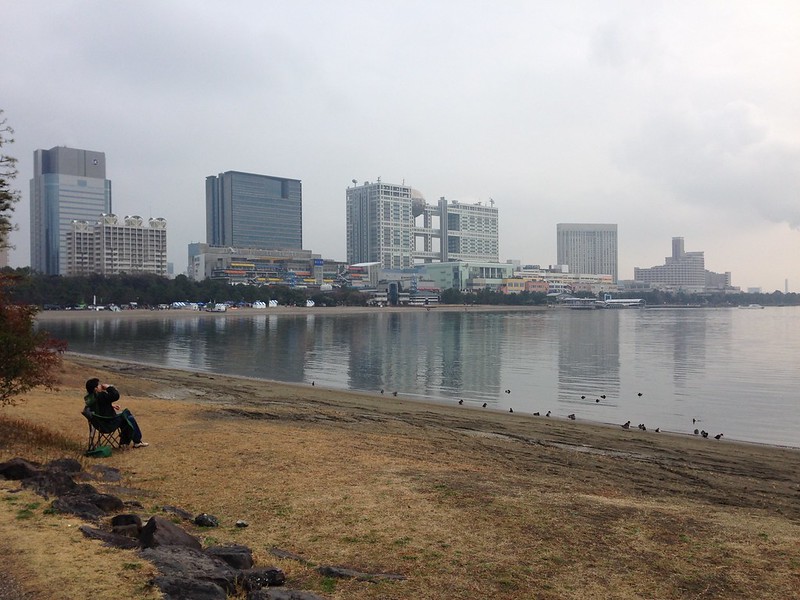
The uncle drinking and feeding pigeons by the sea:
The ruins of the battery:
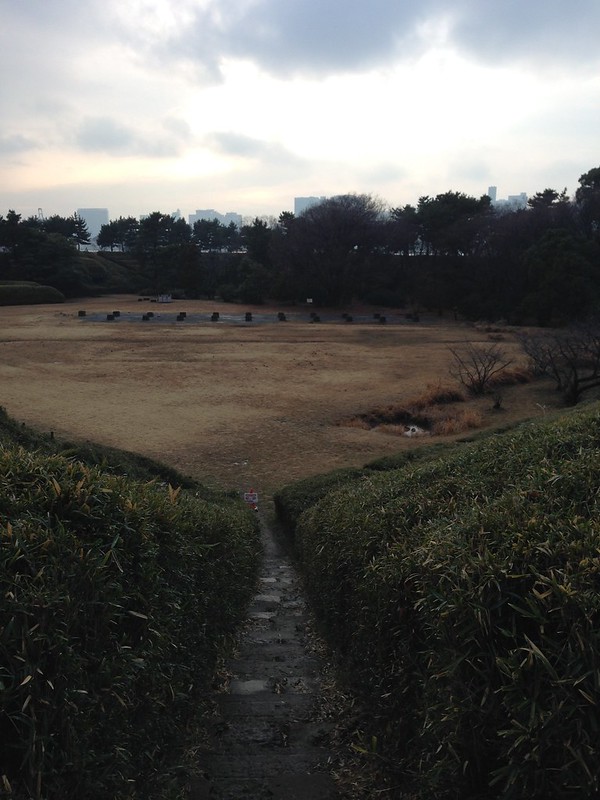 I was the only person on the entire Odaiba island.
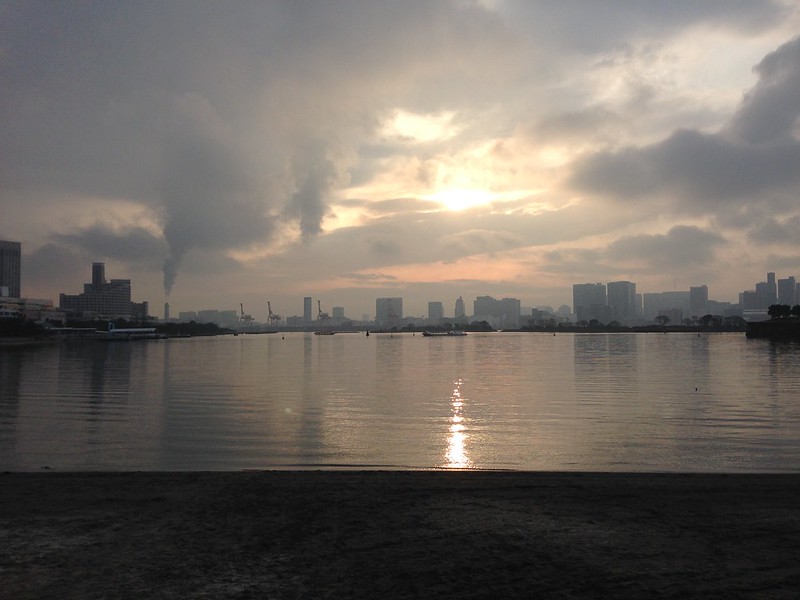
The misty seaside:
Bicycle and Rainbow Bridge:
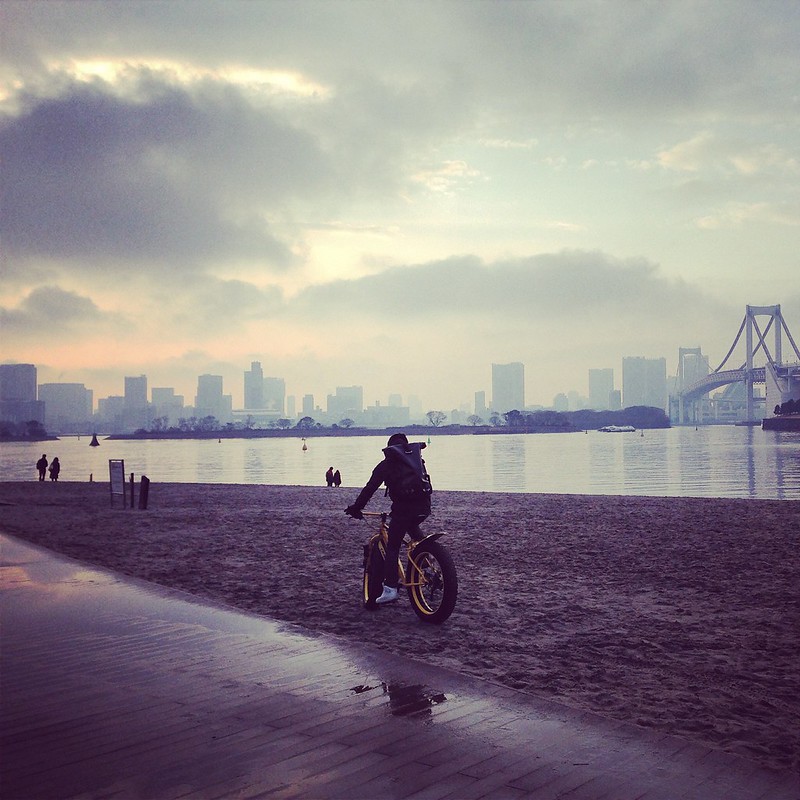
Leaving the bustling commercial area and walking for just 10 minutes allows one to appreciate such secluded and beautiful sea views. It seems that as long as you pay attention to the details in life, there will always be new discoveries and surprises.
End