Shigeo Shibata Captures the Chinese Navy Intercepting a Soviet Heavy Nuclear-Powered Missile Cruiser — Part 1
Note: The user provided a very long text. I need to translate the content while adhering to the specific terminology and tone. Key terms check:
- 伏龙芝号 -> Frunze
- 重庆舰 -> Chongqing (DDG 133)
- 轻型螺旋桨飞机 -> Light Propeller Aircraft (matches context)
- 赛斯纳172 -> Cessna 172
- 失速 -> Stall (Not applicable here, but kept in mind)
- 拦截 -> Intercept
- 航向 -> Heading
- 航速 -> Speed / Knots
- 基洛夫级 -> Kirov-class
- 现代级 -> Sovremenny-class
Let’s draft the translation blocks.
Title/Intro: Beijing’s “Modern Ships” magazine once published an article… …introducing the works of “Japan’s most famous aerial photography master, Mitsuo Shibata”… the Chinese Navy’s 133 “Chongqing” ship rushing towards the Soviet Navy’s “Frunze” heavy nuclear-powered missile cruiser.
Paragraph 2: Regarding Mitsuo Shibata… …“Drifting Front” (Hyoryu Zensen)… …passed away on January 18, 2015…
Paragraph 3: To thank him for leaving us such precious historical photos… …translate some details from the book…
Quote: “Regarding the background of this photo, the explanation did not elaborate much…”
Planning/Strategy (1985-09-30): First Brainstorming Meeting… Shibata: …Frunze is finally coming… …left Severomorsk… passed Cape of Good Hope… Mr. A: …reference the routes of Minsk and Novorossiysk… …Minsk’s route is more valuable… Mr. B: (Looking at the chart)…70 days to Malacca… …Early December… Shibata: …test voyage… freezing period… First or second week of November… Mr. A: …Iran-Iraq war… Hormuz… Shibata: …flagship capability… aircraft carrier… Mr. B: …Kara-class… …Ocean-75 exercise… …lack of flagship capability… Mr. A: …Singapore 1st week… Okinawa/Tsushima 3rd week… Shibata: …let’s go with this plan… Mr. B: …blueprints… displacement 28,000 tons… SS-N-19… SS-N-9… container ship…
1985-10-11: Second Meeting… Socotra Island… Mr. A: …Port at Socotra… Mr. B: …Aden… Shibata: …Nov 3-4 or Nov 10-11… Mr. B: …why not 5-9?… Shibata: …Saturday night/Sunday morning… …coast guard relaxes… Mr. A: …helicopter… Singapore… Okinawa/Naha… Nagasaki… Shibata: …Permits…
1985-10-30: Third Meeting… Central Indian Ocean… Shibata flies to Singapore… Hotline…
1985-11-03: Phone call… Thunderstorms… Cessna 172… Soviet Modern-class destroyer (Sovremenny)… …not enough fuel…
1985-11-06: Frunze enters Cam Ranh Bay.
1985-11-16: Philippine Sea… US P-3C…
1985-11-17: …Atsugi Base… P-3C… Bashi Channel… poor visibility…
1985-11-18: …ANA Flight 81… Okinawa…
12:30 Call: Tokyo: …Iriomote Island… SSW 25km… 8-9 knots. Shibata: Heading?
15:15 Call: …Separating… 25 knots…
19:30 Call: …Between Yonaguni and Iriomote…
Map description: …Frunze route marked as thick line (2)… Minsk as thin line (1)…
Update 2018: …South China Sea… interception… US Decatur vs Chinese Lanzhou…
Comments: Richard Philodraco (Zhang Qian)… author of the original article…
Formatting checks:
- Use bolding … for emphasis.
- Use blockquotes
…
. - Preserve links ….
- Preserve images
.
- Preserve code blocks if any (none in text, but lists exist).
Let’s finalize the output.
Beijing’s Modern Ships magazine once published an article titled “The Brave Posture of the Chinese Navy Through the Lens of a Japanese Photographer” in its December 2011 issue. It introduced the work of “Japan’s most famous aerial photography master at the time, Mitsuo Shibata,” featuring the Chinese Navy’s 133 “Chongqing” ship rushing towards the Soviet Navy’s “Frunze” heavy nuclear-powered missile cruiser.
I had known about Mitsuo Shibata for quite some time and even owned several of his books. In fact, his 1985 book Drifting Front (Hyoryu Zensen) contained a detailed account of the incident involving the Chongqing ship and the Frunze. Regrettably, last Sunday, January 18, 2015, Mitsuo Shibata passed away due to illness at the age of 68.
To express our gratitude for him leaving us such precious historical photos, I plan to translate some details from his book so that everyone can understand what kind of person Shibata was and under what conditions he took these photos. After all, as can be seen from the Modern Ships article, the author did not have much first-hand information:
"Regarding the background of this photo, the explanation did not elaborate much, nor did it mention the exact time and location. It merely mentioned that this was a scene where the Chinese Navy encountered the *Frunze* while it was passing through the East China Sea on its way to Vladivostok to join the Pacific Fleet after being dispatched to the Far East."Furthermore, some erroneous explanations were made based on personal speculation.
First of all, Mitsuo Shibata was a freelance photographer who ran his own private photography studio in Tokyo, and his works mostly covered aviation and maritime subjects. In the postscript of Drifting Front, Shibata wrote about his motivation for flying around the world to photograph the movements of various countries’ armed forces:
 One year, after interviewing the Paris Air Show and looking at the bustling Champs-Élysées, Shibata suddenly realized that this nation of fashion and art was actually the world’s third-largest arms exporter at the time. He was perplexed by the stark contrast between this cultural capital supported by the trade of lethal weapons, which set him on the path to reporting on world defense and the military strength of various nations. Shibata wrote that as individuals, everyone is kind and amiable, but why is it that once it involves groups and develops to the level of nations, humans must spend vast amounts of manpower and resources to develop weapons and slaughter each other?
Although he did not find the answer, he always tried every means to collect intelligence on military developments around the world, going to the scene in person, and personally shooting and recording them for his readers. The 1985 encounter between the Frunze and the Chinese Navy was one of the excellent works in his series of reports.
At the scene at that time, the most powerful military forces of various countries (US, USSR, China, Japan, South Korea) were gathered. On Shibata’s side, however, he had only rented a light propeller aircraft—a Cessna 172 (one piston engine, 4 crew members)—and carried 4 Nikon cameras and 60 rolls of film. In the face of the terrifying, massive weapon weighing tens of thousands of tons, the power of the individual seemed insignificant. But it was this strong belief in recording the scene and thorough preparation that allowed Shibata to leave us extremely valuable historical materials.
Frunze Photography Record Part 1
September 30, 1985 First Brainstorming Meeting Shibata Mitsuo Studio, Harajuku, Tokyo After receiving intelligence that the Frunze passed the Cape of Good Hope on September 27
Shibata: Just as I mentioned when contacting everyone, the Frunze is finally coming. It departed from the Northern Fleet’s Severomorsk base in August, reached the west coast of Africa two weeks ago, passed the Cape of Good Hope on the 27th, and entered the Indian Ocean. The purpose of today’s meeting is to analyze the future movements of the Frunze fleet and decide when and where to shoot.
Mr. A: To formulate a plan, let’s refer to the routes of the Minsk aircraft carrier in June ‘79 and the Novorossiysk aircraft carrier in February ‘84.
However, since Novorossiysk stayed in the Arabian Sea after passing the Cape of Good Hope at that time, Minsk’s route is more valuable as a reference.
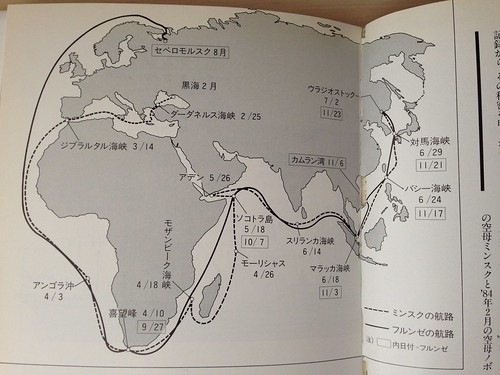
Mr. B: (Looking at the route chart) Minsk passed the Cape of Good Hope on April 10 that year and took 70 days to reach the Strait of Malacca. Calculating this way, Frunze will be there in early December.
Mr. A: But during the Minsk period, to put pressure on the Tokyo Summit of Developed Nations, they deliberately slowed down to pass through the Tsushima Strait (the strait between South Korea and Japan, one of the busiest waterways in the world) on June 28-29.
Shibata: Calculating purely based on last time, it is indeed early December. But considering from the perspective of the Soviet Pacific Fleet, After the Frunze arrives, it will definitely undergo a test voyage after brief maintenance. Therefore, if the test voyage is conducted one month before the icing period, spending one week for the test and two weeks for maintenance before that, Calculated this way, it will pass through Malacca around the first or second week of November.
Mr. A: In the current Iran-Iraq war, Iran has declared it will blockade the Strait of Hormuz to retaliate for the bombing of Kharg Island. Could this make the Frunze patrol the Strait of Hormuz like the Novorossiysk did?
Shibata: I don’t think so. After all, the Soviet Pacific Fleet urgently needs the flagship capability of the Frunze right now. Without a flagship, their aircraft carriers cannot exert their full power.
Mr. B: Speaking of flagship capability, the Pacific Fleet currently only has one Kara-class cruiser, the Petrozavodsk. The formation of 7 ships that departed from Novorossiysk to the Pacific in March this year can be said to be a reenactment of the large-scale “Ocean-75” (Океан-75) exercise. Through this exercise, I believe the Pacific Fleet has keenly felt the insufficiency of flagship capability.
Mr. A: If we extrapolate this way, passing Singapore in the first week of November, and Okinawa and Tsushima Strait in the third week.
Shibata: That sounds about right. Let’s proceed with this plan.
Mr. B: To study from what angle to shoot, I brought the blueprints of the Frunze. The largest nuclear-powered cruiser in the West is the US Virginia-class, with a displacement of only 10,000 tons, whereas the Frunze is 28,000 tons. The reason for building it so large is mainly because the Soviet Union lacks overseas ocean bases. Therefore, to carry sufficient supplies, equipment for various air-to-ship, anti-ship, and anti-submarine weapons, various combat systems, large computers, and air conditioning equipment, etc., requires a huge amount of electricity. To equip nuclear power, a large amount of space is needed, so it ended up being so huge in the end. The key point for photography should be the SS-N-19 vertical launch system on the front deck. Also, the SS-N-9 launcher on the stern is not present on the Kirov. Regarding the bridge, the antennas for satellite communication and electronic warfare have been reinforced. The overall ship silhouette can be said to look somewhat like a container ship.
Shibata: It sounds really hard to shoot. If we’re not careful, it will look like a container ship… Let’s do our best.
October 11, 1985 Second Brainstorming Meeting Shibata Mitsuo Studio, Harajuku, Tokyo After receiving intelligence that the Frunze passed Socotra Island (Yemen) on October 7
Mr. A: Frunze is currently in the port of Socotra Island in South Yemen. It is unknown exactly how many days it will rest. When the Minsk aircraft carrier came, it took a month from this island to Malacca.
Mr. B: But at that time, it stopped in Aden for eight days.
Mr. A: Assuming we ignore that and calculate based on one week of rest at Socotra, departing on October 13, it will reach the Malacca Cape before November 5-13.
Shibata: November 3-4, or November 10-11.
Mr. B: Why not consider November 5-9?
Shibata: Based on the experience with Minsk at that time, they might use the time late Saturday night and early Sunday morning. The coastal guard forces of countries around Malacca relax on weekends.
Mr. A: Okay, let’s go with this schedule. For November 3 & 4, and 10 & 11, we need to rent the helicopter from the Singapore side. For the Okinawa Naha side, that will be 7-8 days later, and Nagasaki 10 days later.
Shibata: I will leave for Singapore on October 23 to get permits from the Aviation Authority and the Ministry of Defense. I hope to get the helicopter sorted out…
October 30, 1985 Third Brainstorming Meeting Cafe near Shibata Mitsuo Studio, Harajuku, Tokyo
Confirmed that the Frunze has entered the central Indian Ocean. Decided that Shibata will fly to Singapore on November 2, and a hotline phone was established between Tokyo and Singapore.
November 3, 1985 Phone Conference Record between Singapore and Tokyo
Shibata: The weather in Singapore is thunderstorms, the airport is closed. Waited until 1:30 PM to get takeoff clearance. Over the South China Sea, I vaguely saw the shadow of a Sovremenny-class missile destroyer through the gaps in the cumulonimbus clouds, but unfortunately, I didn’t have enough fuel and had to return. Too bad.
Tokyo: It doesn’t matter, there is still Okinawa next. If not Okinawa, there is the Tsushima Strait. Let’s start from zero again.
November 6, 1985 The Frunze enters Cam Ranh Bay base, Vietnam.
November 16, 1985 The Frunze suddenly appeared in the waters west of the Philippines. The US military announced in the evening that it would dispatch a P-3C for media coverage to the relevant waters. Shibata immediately applied to join.
November 17, 1985 At 6:00 AM, boarded the US military P-3C that took off from Atsugi Base and flew towards the Bashi Channel. However, due to encountering cold air, visibility was extremely poor. Although the Soviet fleet was seen, photography was impossible. Flew back to Atsugi Base in the evening. Total flight time was 10 hours and 35 minutes.
November 18, 1985 Flew to Okinawa on All Nippon Airways Flight 81.
12:30 PM Phone Conference Record between Tokyo and Okinawa
Tokyo: 25km South-Southwest of Iriomote Island. Speed 8-9 knots.
Shibata: What is the Heading? Is it between Okinawa and Miyako?
Tokyo: Still unknown.
15:15 PM Phone Conference Record between Tokyo and Okinawa
Tokyo: The Frunze and the Sovremenny-class have separated and are moving south. Speed 25 knots.
Shibata: The exercise has begun, hasn’t it? When did it happen?
Tokyo: Sources are complicated, hard to say. Anyway, moving south at 25 knots.
Shibata: I guess it’s an anti-submarine exercise. There must be US submarines stalking them from behind.
19:30 PM Phone Conference Record between Tokyo and Okinawa
Tokyo: They assembled 20km west of Iriomote Island in the evening. It looks like they will pass through between Yonaguni and Iriomote.
Shibata: Soviet warships have never taken this route before (always between Okinawa and Miyako). They must want to make passing through the Bashi Channel routine through this anti-submarine exercise, plus it saves a lot of distance. This exercise is also testing Japan’s reaction.
Tokyo: Probably. Following this route, tomorrow morning they will be 320km west of Yakushima Island. We need to hurry.
Shibata: Here, Kadena Air Force Base is conducting a large-scale exercise, and takeoffs and landings at Naha Airport are restricted. It’s a state of war.
Tokyo: Can you fly?
Shibata: No matter what, we must fly.
The route of the Frunze this time is marked with a thick line in the map below, labeled as No. 2. The previous route of Minsk is the thin line labeled No. 1.
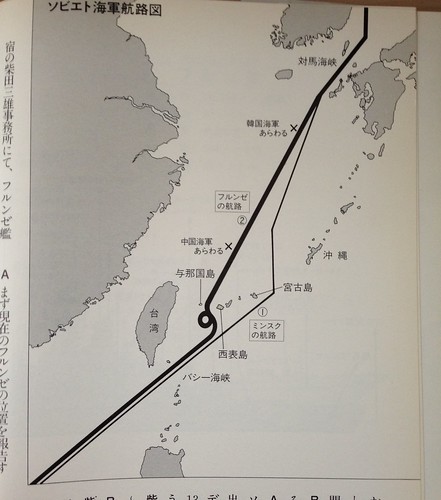 The location where the Chinese Navy was photographed is marked with a cross on the map, i.e., the place marked “Chinese Navy Appears” (中国海軍あらわる).
Frunze Photography Record Part 2
2018/10/04 Update Recently, a similar naval interception event occurred in the South China Sea waters, but the intercepted party changed from the Soviet Union to the United States. Sina: US Military Releases Photos of Our Ship Driving Away US Ship, High-Speed Intercept Forces Turn (Photo) Ming Pao: US Military Releases Photos of Near Collision Between Chinese and American Ships in South China Sea
After the US destroyer USS Decatur entered the territorial waters of China's reefs in the Spratly Islands on September 30, the PLA Navy's Type 052D destroyer *Lanzhou* verified and warned it to leave. The maritime news website gCaptain published several photos provided by the US Navy on Tuesday. The photos show *Lanzhou* and USS Decatur in a standoff, with the two warships very close, and the US ship had to turn to avoid danger. The photos published by gCaptain show that the Chinese Navy's *Lanzhou* and the US military's *Decatur* were almost bow-to-stern. The US Navy previously stated that the closest distance between the two ships at that time was 41 meters. To avoid collision, *Decatur* had to turn. The photo shows *Decatur* drawing a white line on the sea when turning.The article and photos from gCaptain are here: Photos Show Confrontation Between USS Decatur and a Chinese Navy Warship in South China Sea