New RNP AR Approach Procedure at Toyama Airport RJNT
According to the eAIP Japan AIP published on 13 NOV 2014, Toyama Airport will commence the use of RNP AR approach procedures starting in December. Let’s take a detailed look below.
First, let’s look at the simpler RNAV (RNP) Y RWY20. As shown in the figure below, the large “RNP AR” text and “Special Authorization Required” in the lower right corner indicate that this is a procedure requiring special authorization, specifically an RNP AR APCH. Performance Based Navigation (PBN) and RNP AR APCH were introduced in this site’s article PBN (Performance Based Navigation).
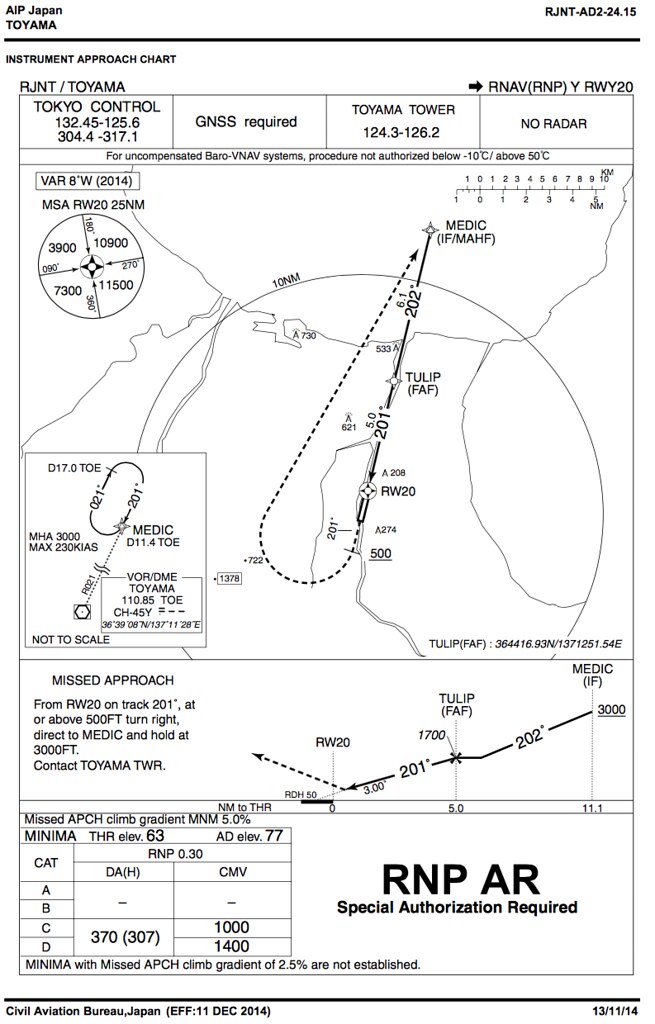 Here are other points of personal interest, listed from top to bottom:
“GNSS Required”, meaning aircraft executing this procedure must be equipped with a Global Navigation Satellite System (GNSS) receiver.
“For uncompensated Baro-VNAV systems, procedure not authorized below -10°C/ above 50°C”,
For uncompensated Baro-VNAV systems, procedure execution is restricted to temperatures between -10°C and 50°C.
The Intermediate Fix (IF) is MEDIC, located over Toyama Bay.
The Final Approach Fix (FAF) is TULIP.
The MINIMA section is the most critical, requiring RNP 0.30, which means a Total System Error (TSE) of ±0.3 NM;
The Decision Altitude (DA) for Category C and D aircraft is 370 feet, and Decision Height (DH) is 307 feet.
Compared to the two existing procedures—the DA of 470 for RNAV(GNSS) RWY20 and the MDA of 470 for LOC Z RWY20—this is 100 feet lower.
This demonstrates the advantage of using RNP AP APCH, allowing for continued descent in adverse weather conditions even with low cloud ceilings;
The Converted Meteorological Visibility (CMV) is 1000 meters for Category C aircraft and 1400 meters for Category D aircraft.

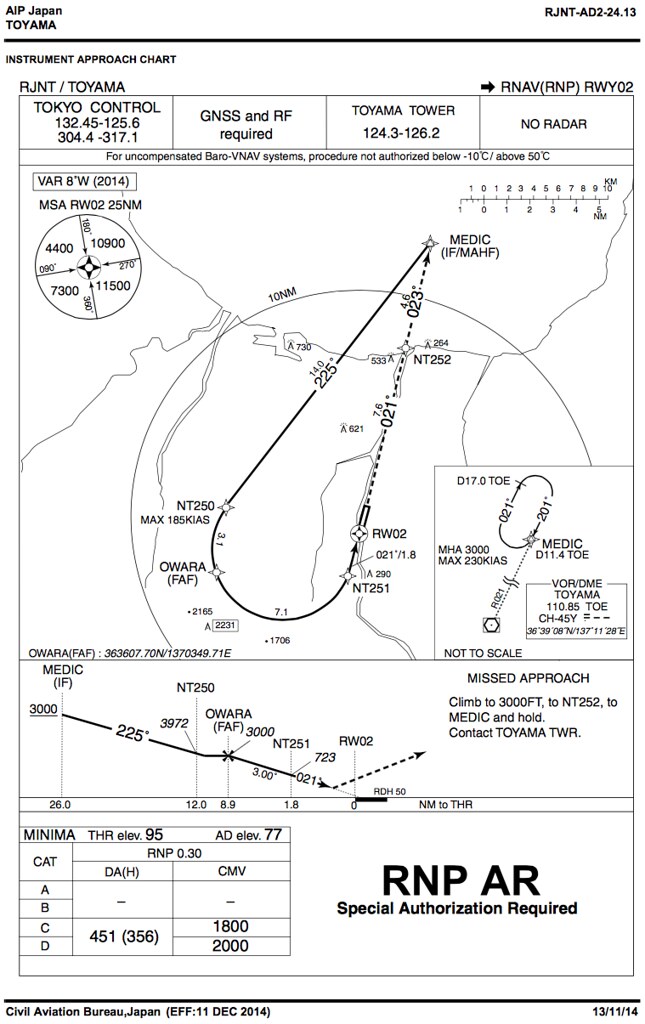
Now let’s look at RNAV(RNP) RWY02. The IF is MEDIC as before, and the FAF is a newly designated waypoint, OWARA.
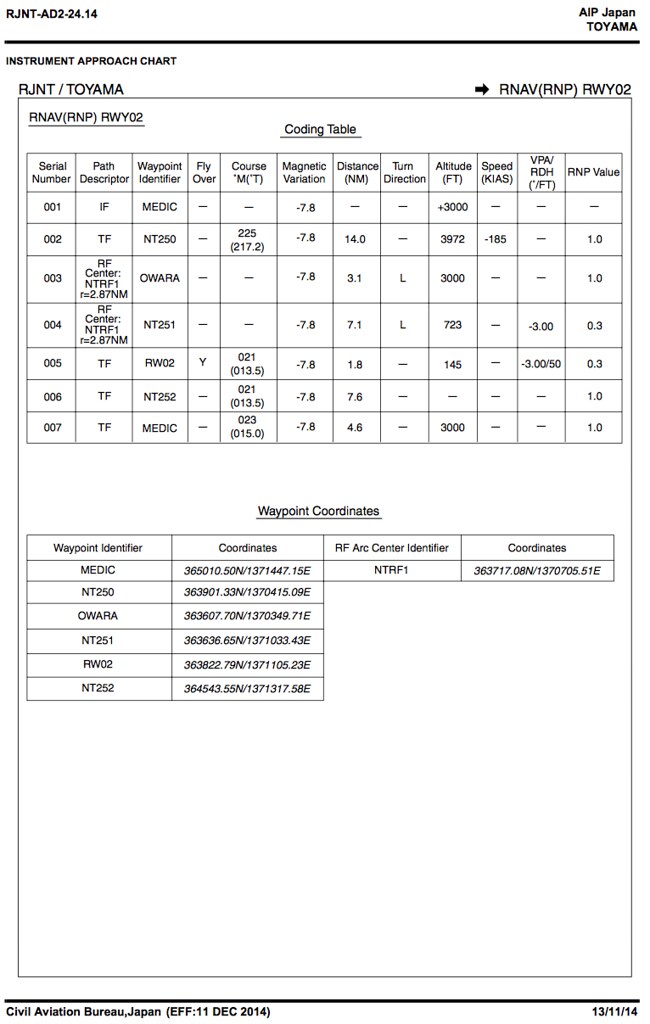
Since the aircraft needs to turn around in the air, the NT250 and NT251 curved legs with a Radius to Fix (RF) of 2.87 NM have been established.
Furthermore, the FAF is located within the arc; this procedure truly leverages the RNP AP APCH capability to flexibly set flight paths.
The Decision Altitude (DA) in the MINIMA section is 451, which is significantly lower than the MDA of 630 for LOC Z RWY20.
The CMV for Category D aircraft is 2000 meters, a significant improvement compared to the VIS of 3200 meters for LOC Z RWY20.
(Of course, this isn’t a direct comparison; I will write a study note on CMV later.)
How many aircraft in Japan are airworthy for RNP AR APCH? There is an Excel file on the JASMA website where you can see the latest list of aircraft. For example, today it looks like this: RNAV/RNP Approved Aircraft registered in Japan JASMA RNAV/RNP Approvals as of 31 Oct 2014 (Excel) If you are interested, you can download it to take a look. Column O in the Excel file is “RNP AR APCH Approved”. You can see that most are “No”. Out of 819 total aircraft, only 215 are capable of flying RNP AP APCH. The aircraft types are also quite simple: for JAL, only the 737NG; for ANA, only the 787 and 737NG; and not a single one from other companies!!
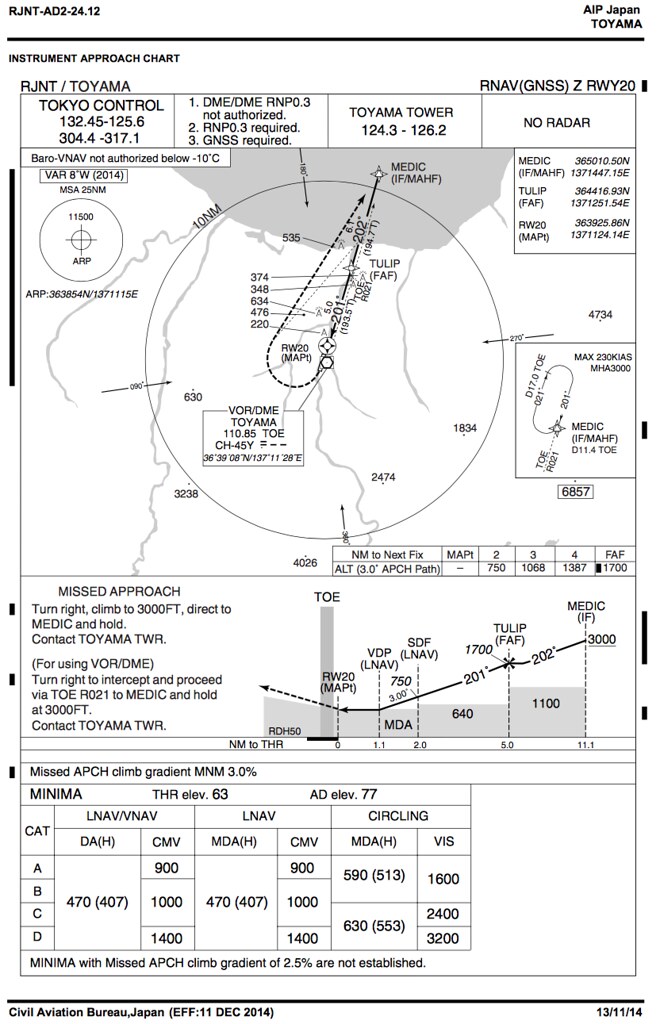
Finally, for comparison, I am posting the new RNAV(GNSS) Z RWY20. You can see the DA is 470. Also, the missed approach procedure for the existing RNAV(GNSS) RWY20 has been changed from a left turn to a right turn. Old Toyama Airport charts can be found <a href=https://yinlei.org/x-plane10/view.php?file=doc/AIP-J/RJNT_Toyama.pdf>here on this site.
Reference https://aisjapan.mlit.go.jp/html/AIP/html/20141113/eAIP/20141211/pdf/JP-AD-2.24.18-RJNT-en-JP.pdf?amdt=show https://aisjapan.mlit.go.jp/html/AIP/html/20141113/eAIP/20141211/pdf/JP-AD-2.24.17-RJNT-en-JP.pdf?amdt=show