Converting Meteorological Visibility to CMV
When viewing Japanese aeronautical charts, it is common to see CMV (Converted Meteorological Visibility) used in the Landing Minima. This metric is used when the airport does not have RVR equipment or when the equipment is inoperative. CMV needs to be calculated using METAR or ATIS. The conversion is divided into Day and Night, and takes into account the status of lighting equipment. The CMV value is obtained by multiplying the Meteorological Visibility VIS by a factor.
This factor can be found in the Aeronautical Information Manual AIM-J (Japan) currently at hand:
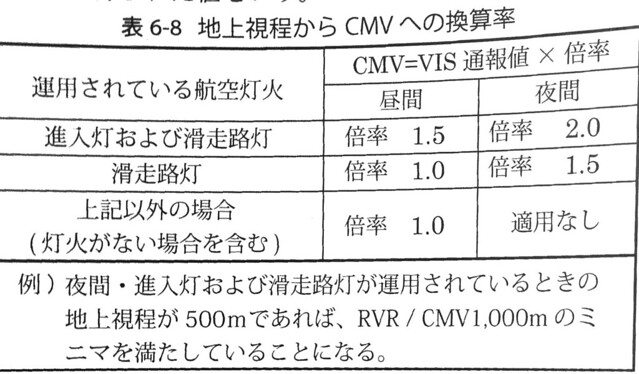 Namely:
With high-intensity approach lights and Runway lights: Day CMV = VIS * 1.5 Night CMV = VIS * 2.0
With Runway lights: Day CMV = VIS * 1.0 Night CMV = VIS * 1.5
With other lighting equipment (including no lights): Day CMV = VIS * 1.0 Night Not convertible
Namely:
With high-intensity approach lights and Runway lights: Day CMV = VIS * 1.5 Night CMV = VIS * 2.0
With Runway lights: Day CMV = VIS * 1.0 Night CMV = VIS * 1.5
With other lighting equipment (including no lights): Day CMV = VIS * 1.0 Night Not convertible
For example, at night with approach lights and Runway lights, the factor is 2. If the Visibility is 500 meters, an RVR/CMV of 1000 meters can be obtained.
Note that when an RVR report is available, RVR must not be converted back into Visibility. Also, CMV must not be used for takeoff, Category II and Category III precision approaches, or visual circling. Furthermore, CMV is used to determine the Landing Minima weather standards; it presumably should not be used for dispatch operations such as flight planning and release.
Additionally, I found a document online from 2012 regarding negotiations between the JAL labor union and the company management. It appears that some pilots were dissatisfied with the definition of CMV, feeling it lacked a theoretical basis, and were concerned that using CMV lowers the Decision Height, which could lead to an increase in Go arounds and Missed Approaches in the future. However, I did not find any follow-up, so I do not know the result of the discussions regarding CMV safety.