Follow-up Report on Lifting the Ban on Electronic Device Use on Aircraft in Japan
A few days ago, I wrote about the decision by the Japanese Ministry of Land, Infrastructure, Transport and Tourism to lift the ban on the use of electronic products during takeoff and landing. At that time, it was still a rumor, but yesterday I saw official materials, which are even more detailed. Here is a brief introduction.
First, you need to know that mobile phones cannot be used on all aircraft. They have categorized aircraft into four classes, and smartphones and similar products can only be used on Class 1 and Class 2 aircraft. Let's look at the table below, which is based on the aircraft's tolerance to radio waves.
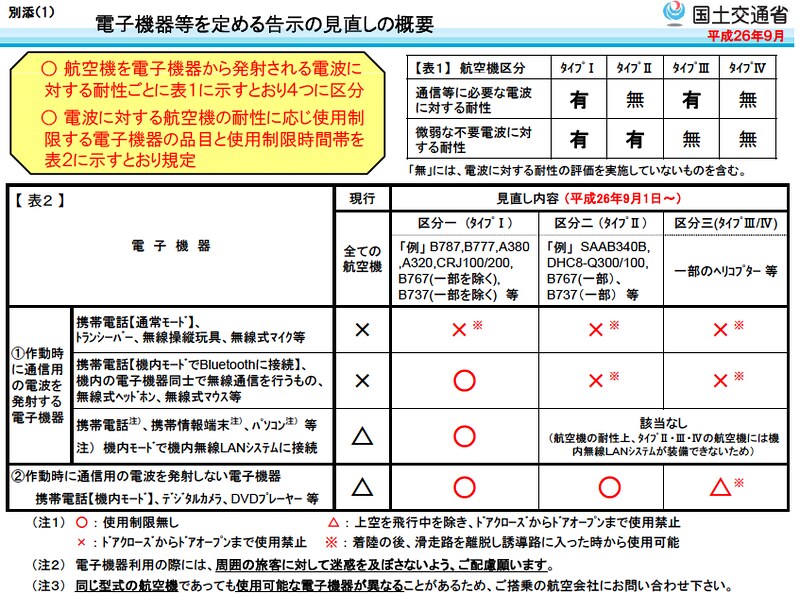
Class 1, which has the strongest tolerance, includes modern passenger jets such as the B787, B777, A380, A320, CRJ100, 200, and some B737s and B767s; I estimate that older 737s like the 737-500 would only fall into Class 2. Class 2 includes the Saab 340, Bombardier Q300/100, and some 757s and 767s; Class 3 includes some helicopters, but the specific classification depends on the regulations of each individual airline.
At the same time, regulations have also been established to categorize electronic products. It's hard to explain this in words, so I've made a table.
| Electronic Products | Existing Old Regulations | New Regulations for Class 1 Aircraft | New Regulations for Class 2 Aircraft | New Regulations for Class 3 Aircraft |
| Mobile phones in general mode, wireless receivers, wireless remote control toys, wireless microphones | Cannot be used | Cannot be used | Cannot be used | Cannot be used |
| Mobile phones in flight mode with Bluetooth communication, products that can communicate with each other, wireless headphones, wireless mice | Cannot be used | Can be used without restriction | Cannot be used | Cannot be used |
| Mobile phones, computers, tablets, etc., in flight mode communicating with the in-flight wireless network | Only usable during cruise | Can be used without restriction | In-flight wireless network not available | In-flight wireless network not available |
| Electronic products that do not emit radio waves, such as mobile phones in flight mode, digital cameras, DVD players, etc. | Only usable during cruise | Can be used without restriction | Can be used without restriction | Only usable during cruise |
Regarding the aircraft's immunity to radio wave interference, newer aircraft models generally have stronger capabilities, while older airframes lag behind quite a bit. I have on hand a memoir by a JAL captain titled "10,000 Days of a Captain" (機長の一万日), written in the late 1990s. It records a story from when he was flying a Boeing 747-200. While in autopilot mode, a certain instrument suddenly displayed an anomaly. He immediately disengaged the automatic mode and began manual flying while checking for the source of the failure. Of course, after checking for a long time, he couldn't find the problem, so he used the intercom to ask the flight attendants to check if any passengers were using their mobile phones. The flight attendants indeed found someone making a call (at that time, there were no regulations prohibiting the use of phones on board). After persuading the guest to turn off the phone, the abnormal instrument display immediately returned to normal. Through this example, we can see that many instruments are very sensitive to radio wave interference.
Below is a specific explanation of various electronic products. It is basically the same as the table above, so I won't explain them one by one here.
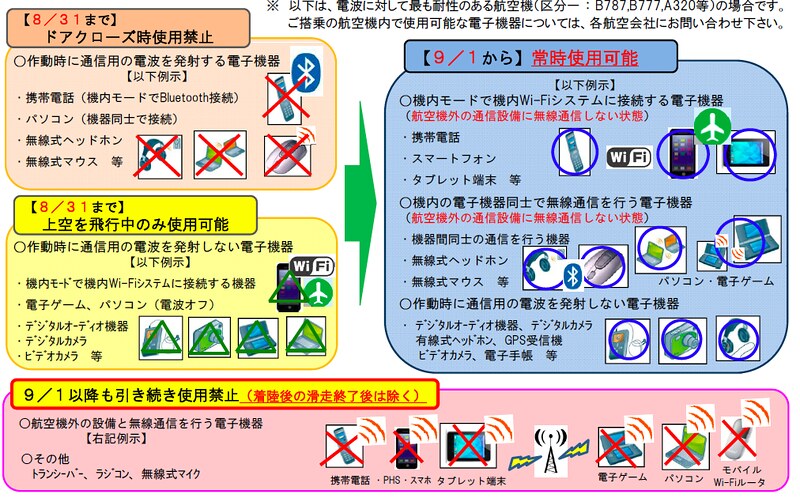
Finally, there is one more very important point: after September 1st, once the aircraft has cleared the Runway and is on the Taxiway, all electronic products can be used. Currently, airline announcements generally require the aircraft to taxi to the Jet Bridge and come to a complete stop before allowing passengers to use their mobile phones. In the future, after the aircraft lands, passengers can report their safety to their families sooner.
End