Buffet Margin
The buffet boundary is the second most important aerodynamic performance parameter in aircraft design, following the Lift-to-Drag ratio (L/D).
Wing buffet is the random excitation response of the wing structure to pressure pulsations caused by airflow separation. When an aircraft flies at low speeds and high angles of attack, buffet occurs once the airflow separation on the lifting surfaces reaches a certain degree. This type is referred to as lift-type buffet.
The curve of the lift coefficient corresponding to the buffet onset angle of attack against Mach number is called the buffet boundary. The higher the buffet boundary, the lower the minimum level flight speed of the aircraft, and the better its maneuverability and safety in flight.
The buffet boundary parameter (M²CL) is the product of the square of the Mach number and the maximum usable lift coefficient. When the buffet boundary value is exceeded, the wake (turbulence) from the separated airflow on the wing usually acts on the tail, causing unacceptable aircraft buffet.
The buffet boundary typically corresponds to the appearance of a “certain area” of separated airflow on the wing. Since the maximum cruise lift coefficient of commercial airliners is limited by the onset of buffet at 1.3g load factor (approximately a 40-degree bank maneuver by the pilot or encountering severe gusts), it is almost as important as drag in determining raw aircraft performance data.
The peak of the buffet boundary determines the maximum altitude an aircraft can maintain at a given wing loading. If the buffet boundary is lower, in order to maintain a 0.3g load margin between the cruise lift coefficient and the buffet boundary, the desired cruise lift coefficient must be reduced, leading to a lower cruise altitude. Since the fuel consumption rate of jet engines increases with decreasing altitude, fuel efficiency is also reduced. Additionally, this may result in an inability to fully utilize the cruise altitude range assigned by Air Traffic Control, potentially causing a loss of cruise performance.
Modern airliners are designed so that the airframe experiences buffet as a warning when airspeed drops to 107% of the stall speed. Stall speed increases with aircraft weight and altitude. That is, at the same speed, a heavier aircraft or one flying higher will have a higher stall speed.
The stall speed specification refers to the aircraft’s speed under level flight conditions. However, when the aircraft is banked, such as during a turn, the stall speed increases as the G-force increases.
Therefore, when flying near the buffet onset speed, if the aircraft banks due to air currents, there is a high probability that the aircraft will stall.
G-force can be calculated as 1/COSθ (where θ is the bank angle). For example, 60 degrees results in 2G, and 40 degrees in 1.3G.
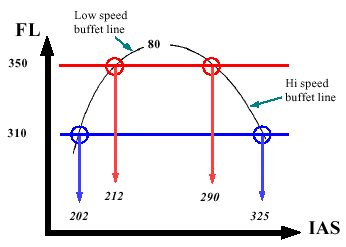
The 1.3G buffet boundary is the speed at which buffet will occur during a 40-degree banked flight. Therefore, when flying at the speed of the 1.3G buffet boundary, even if a 40-degree bank occurs, buffet will not occur.
Generally, airliners fly at speeds above the 1.3G buffet boundary, and bank angles do not exceed 30 degrees, so a safety margin is guaranteed. However, regulations differ regarding turbulence: in light turbulence, a 1.3G buffet boundary is required, while in moderate to severe turbulence, a 1.5G buffet boundary is required.
Let’s look at a case study from a blog by an ANA 744 pilot.
One day, while flying at FL370, he heard another aircraft ahead report moderate turbulence at FL410, and nearby aircraft began requesting climbs to FL430. However, checking the FMS-CDU revealed that the maximum possible altitude was only FL433. If climbing to FL430, the 1.3G buffet boundary would be between 238 and 254 knots. If a 1.3G load factor occurred near this speed, buffet would be highly likely. Therefore, his countermeasure was not to climb but to request a detour to the south to avoid the turbulent airspace.
http://www.dsti.net/Information/ViewPoint/41437 http://www2.plala.or.jp/sin/plalaboard/message/13391.html http://detail.chiebukuro.yahoo.co.jp/qa/question_detail/q1355634013 http://fdc.blog.so-net.ne.jp/2008-06-27