Haneda Airport Expansion Plan
The 2020 Olympics will be held in Tokyo, but as an aviation hub, the throughput of Haneda Airport is approaching its limit, making it difficult to accommodate greater traffic volume.
Therefore, the “Capital Region Airport Function Enhancement Technology Study Subcommittee” of the Japanese Ministry of Land, Infrastructure, Transport and Tourism (MLIT) conducted an investigation and research, publishing improvement proposals last week. These include changing existing Arrival and Departure procedures to increase the number of takeoffs and landings per hour, and there are plans to add a fifth Runway after the Olympics. Let’s introduce a part of the materials below.
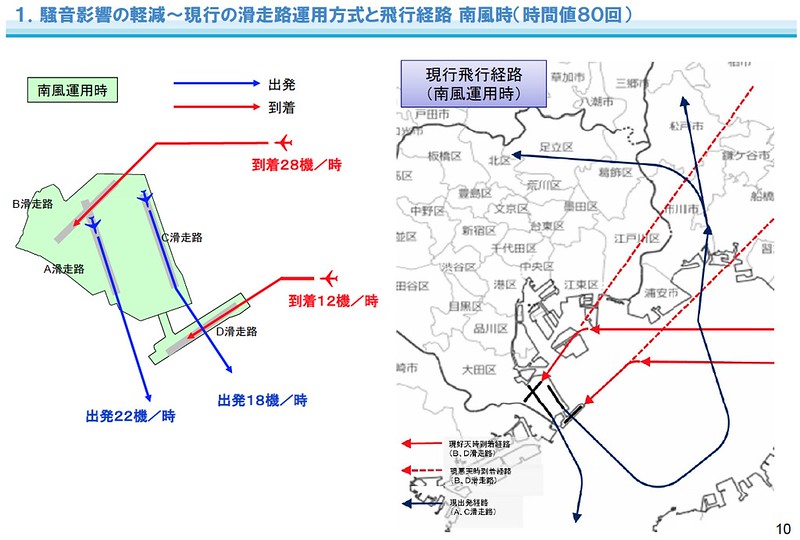
First, let’s look at improvements in Runway usage for Arrival and Departure. For example, when there is a southerly wind, currently 16L/R are used for Departure and 22/23 for Arrival, allowing for 80 flight movements (takeoffs and landings) per hour.
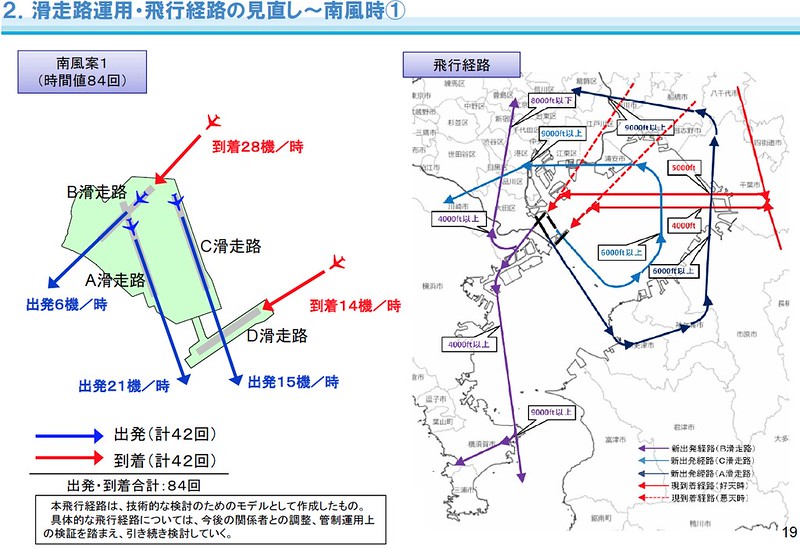
The improvement proposal puts forward two options. Option 1 involves using three Runways (04/16L/16R) for Departure simultaneously, while Arrival remains on 22/23. This allows for 84 flight movements per hour.
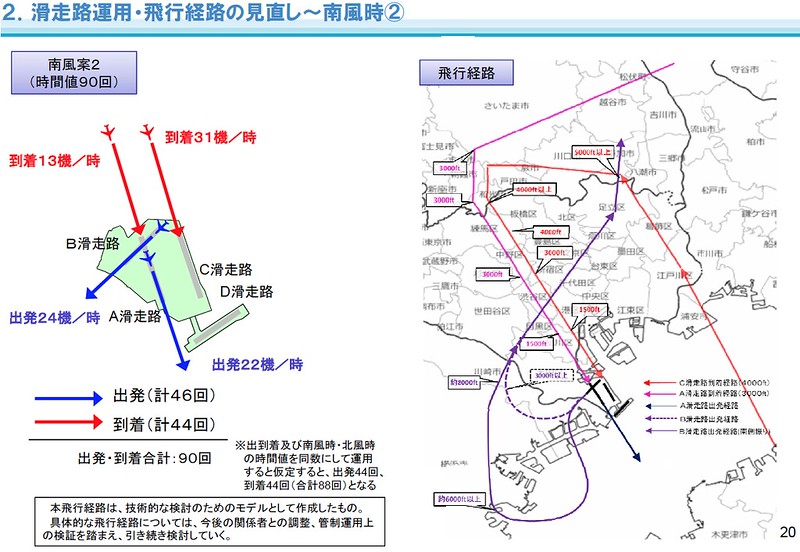
Option 2 uses Runways 04/16L for Departure and 16L/R for Arrival. This method is even more efficient, capable of completing 90 flight movements per hour.
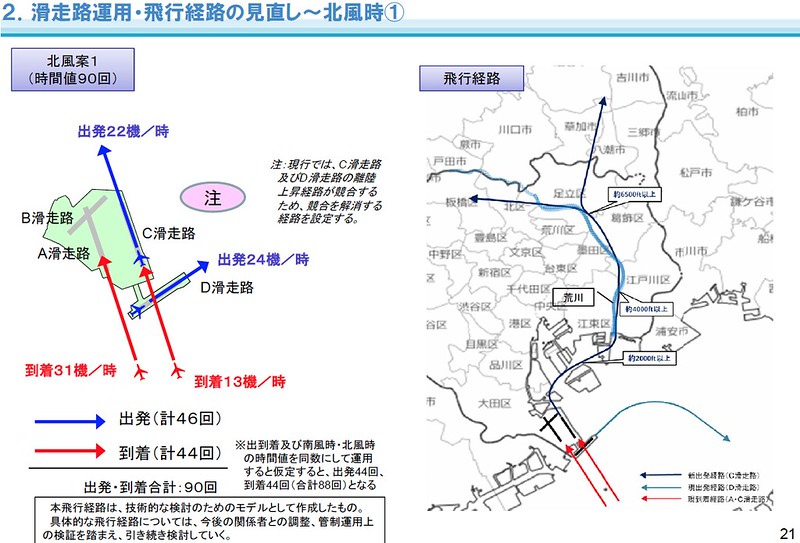
When there is a northerly wind, the current method uses 34L/R for Arrival and 05/34R for Departure, allowing for 80 flight movements per hour.
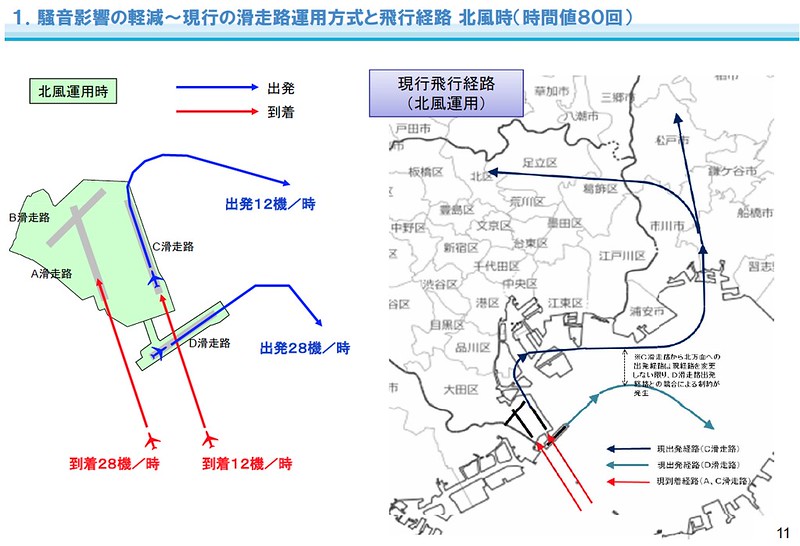
One of the improvement proposals is to keep the Arrival Runways unchanged but alter the Departure routes. For instance, Runway 34R currently requires an immediate right turn after takeoff, followed by a rapid Climb over Tokyo Bay to reduce noise over residential areas. This proposal involves a turn and Climb north over Kasai after takeoff from 34R. This creates separation from aircraft taking off simultaneously from Runway 05, increasing the flow rate to 90 flight movements per hour.
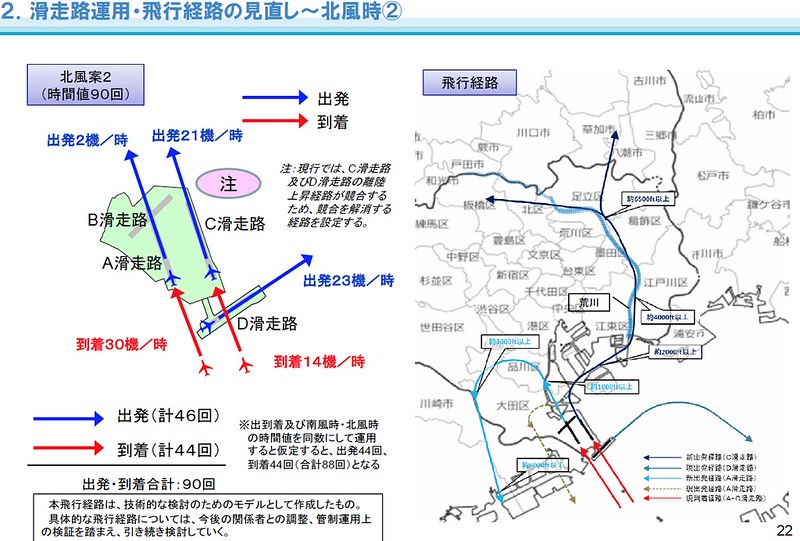
Option 2 similarly uses 34L/R for Arrival, but utilizes all three Runways (05/34L/34R) for Departure simultaneously, which also achieves a capacity of 90 flight movements per hour.
It is not yet known which specific plan the government will decide to adopt, but increasing flow will inevitably increase noise pollution. Therefore, the report suggests providing subsidies to schools, hospitals, and other facilities located under the flight routes for soundproofing renovations or the purchase of new materials. Additionally, because of the increased traffic volume, the existing Apron positions will be insufficient, necessitating the construction of new Apron positions and terminal facilities.
Of course, the above measures address symptoms rather than the root cause, so the report proposes the recommendation of building a new Runway, offering 5 options involving the construction of parallel runways near existing ones.

The operational methods and expected effects for each option can be seen in the figure below.
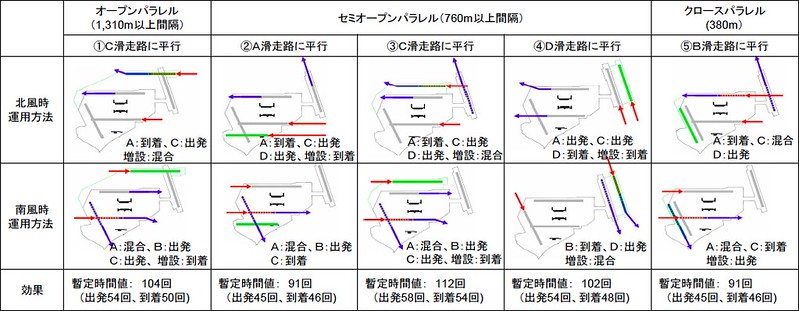
Option 3 in particular would enable the airport to reach a capacity of 112 flight movements per hour, significantly increasing throughput. However, it is clear that this option requires building a Runway in the sea, so the cost is likely to be the highest. In any case, the new Runway definitely won’t be ready in time for the 2020 Tokyo Olympics, so a final conclusion probably won’t be reached for a while yet.