BGAN and Swift Broadband
More and more people are able to access the internet during commercial flights recently.
At airports, it is common to see many passenger aircraft equipped with large satellite communication antenna domes on the upper fuselage.
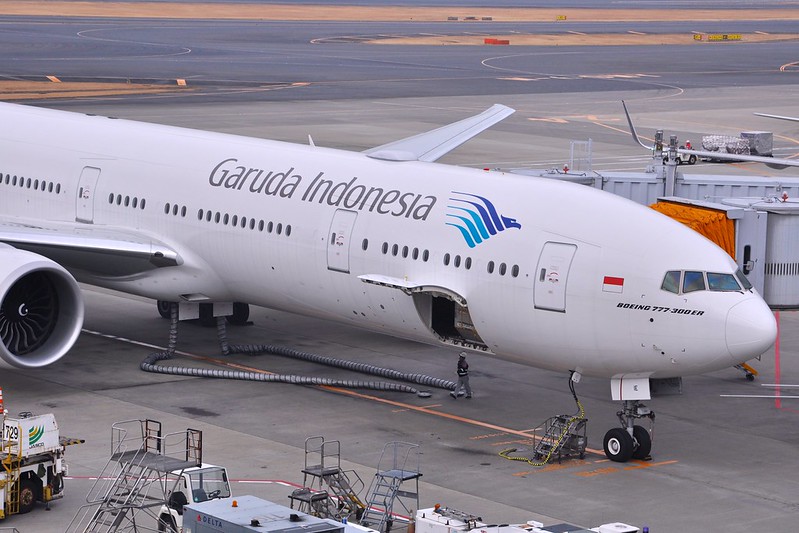 For example, on the Indonesia Air Boeing 777-300ER above, the one directly above the text “Indonesia” is it; the photo was taken at Narita Airport.
Take another look at this Qatar Airways Airbus A330-200, the photo was taken at Beijing Capital International Airport.
For example, on the Indonesia Air Boeing 777-300ER above, the one directly above the text “Indonesia” is it; the photo was taken at Narita Airport.
Take another look at this Qatar Airways Airbus A330-200, the photo was taken at Beijing Capital International Airport.

This involves two terms: BGAN and Swift Broadband.
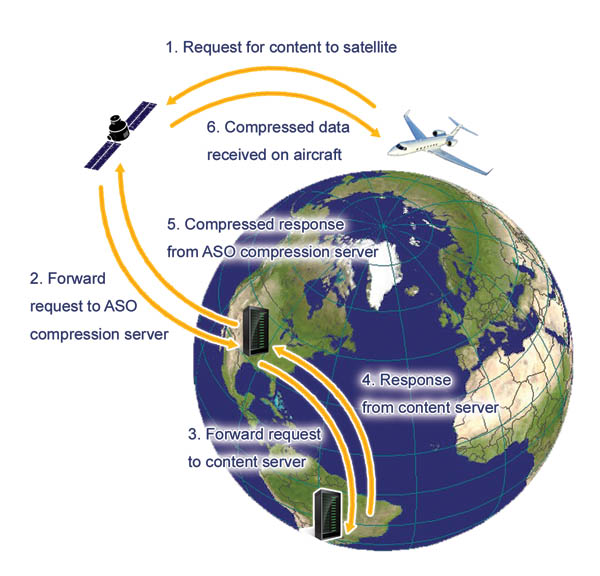 According to the diagram above, communication 1 between the aircraft and the satellite occurs first.
The satellite sends the request to the ground ASO server, which is communication 2.
The ASO server has a cache area; if the content in the cache is up-to-date, it is directly compressed and the response is transmitted back to the satellite.
If the content is not up-to-date or not in the cache, process 3 in the diagram is executed to issue a request to the actual service provider's server.
According to the diagram above, communication 1 between the aircraft and the satellite occurs first.
The satellite sends the request to the ground ASO server, which is communication 2.
The ASO server has a cache area; if the content in the cache is up-to-date, it is directly compressed and the response is transmitted back to the satellite.
If the content is not up-to-date or not in the cache, process 3 in the diagram is executed to issue a request to the actual service provider's server.
For 432kbps speeds, it indeed meets the requirements for basic internet needs. Borrowing an explanation from China Transport Telecommunication & Information Center, the sole operator of Inmarsat in China description,
The Swift Broadband service can support a wide range of crew and passenger applications:
Crew applications:
• Safety operations —- Automatic Dependent Surveillance, data communication between controllers and pilots
• Voice communication
• Electronic Flight Bag, flight plans, weather and chart updates
• Mechanical performance monitoring and major system error reporting
• General operational planning
• Crew reporting and general management
Passenger applications:
• Telephone: seat phones, mobile phones, VOIP, and text messages
• Email, intranet, internet, instant messaging
• Secure VPN access
• Large file transfer —- PPTs, charts, videos
• In-cabin news updates

Hmm, when flying in the clouds without visibility of the terrain, can the crew also check their aircraft’s position on flightradar24?