What is Primer?
A friend on Baidu Tieba asked what a Primer is? After answering, I felt this might be a common question, so I decided to write a short note.
Translating “Primer” into Chinese literally means to inject or add. On small propeller aircraft, the Primer refers to the priming pump for engines with a carburetor fuel supply system (also known as a priming pump, primer valve, primer switch, etc.).
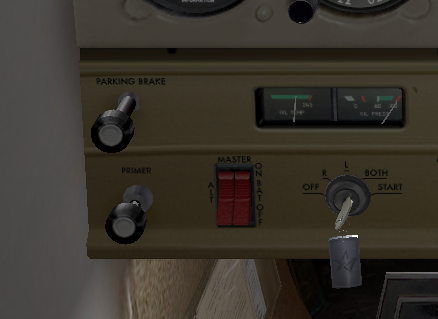
According to this article on the AOPA (Aircraft Owners and Pilots Association) website,
 The Primer acts as a manual fuel pump, allowing fuel to be injected directly into the engine cylinders during a cold start, bypassing the carburetor.
Before the engine starts, the fuel lines are empty. Following the operating manual, you press the Primer button several times before ignition to inject a certain amount of fuel into the cylinders, helping the starter increase the engine speed (RPM).
The Primer acts as a manual fuel pump, allowing fuel to be injected directly into the engine cylinders during a cold start, bypassing the carburetor.
Before the engine starts, the fuel lines are empty. Following the operating manual, you press the Primer button several times before ignition to inject a certain amount of fuel into the cylinders, helping the starter increase the engine speed (RPM).
So, let’s look at the explanation of the primer in the Cessna 172N POH (Pilot’s Operating Handbook),
 To facilitate starting in cold weather, this carbureted engine is equipped with a manual priming pump.
Pulling the plunger of the priming pump draws fuel from the fuel strainer;
pushing the plunger in injects fuel into the intake manifold of the cylinders.
The priming pump plunger knob is located on the instrument panel and has a locking position.
After pushing the knob fully in, rotate it left or right to ensure it cannot be pulled out, thereby locking it.
To facilitate starting in cold weather, this carbureted engine is equipped with a manual priming pump.
Pulling the plunger of the priming pump draws fuel from the fuel strainer;
pushing the plunger in injects fuel into the intake manifold of the cylinders.
The priming pump plunger knob is located on the instrument panel and has a locking position.
After pushing the knob fully in, rotate it left or right to ensure it cannot be pulled out, thereby locking it.
I found Chapter 14: Aircraft Fuel System on the official FAA website’s Aviation Maintenance Technician Handbook, which explains the engine,
 The image above shows the structure of the Primer. You can see the handle on the right, the piston in the middle, and the fuel tank connection on the left.
Chapter 14: Aircraft Fuel System also includes a schematic of the fuel system,
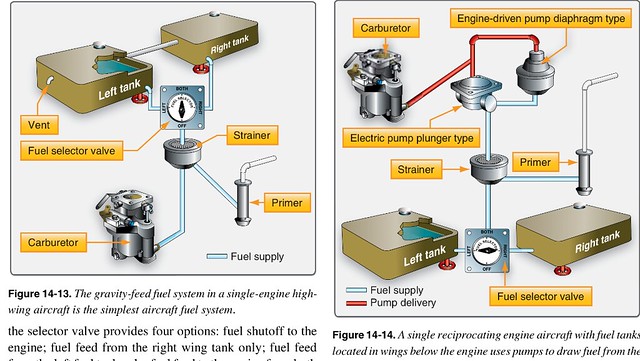
The left image (14-13) shows a high-wing aircraft with a gravity-fed fuel system where the fuel tanks are in the wings. At the top are the left and right fuel tanks, followed by the fuel tank selector valves, and below that is the fuel strainer. To the bottom right of the fuel strainer is the Primer, and to the bottom left is the carburetor.
The right image (14-14) shows a low-wing aircraft with a fuel system where tanks are located in the lower section. At the top is the carburetor, followed by two types of fuel pumps (an engine-driven diaphragm pump and an electrically driven piston pump). Below that are the fuel strainer and the Primer. At the very bottom are the fuel tank selector valves and the left/right fuel tanks.
Next, let’s look at the operation of the Primer.
According to the engine cold start procedure in the Cessna 172N POH (Pilot’s Operating Handbook),
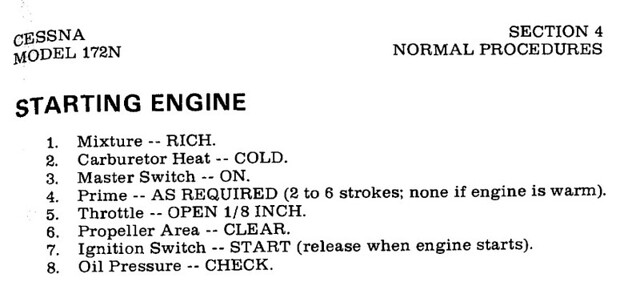 Mixture to Rich, Carburetor Heat on, Master Switch on,
Press the Primer 2-6 times as needed to prime the cylinders (omit for a warm start),
Throttle 1/8 inch, ensure the area near the propeller is clear, then engage the starter and check oil pressure.
Mixture to Rich, Carburetor Heat on, Master Switch on,
Press the Primer 2-6 times as needed to prime the cylinders (omit for a warm start),
Throttle 1/8 inch, ensure the area near the propeller is clear, then engage the starter and check oil pressure.
The “as needed” mentioned above refers to deciding the number of injections based on temperature.
For example, in cold weather conditions, the manual provides the following instructions,
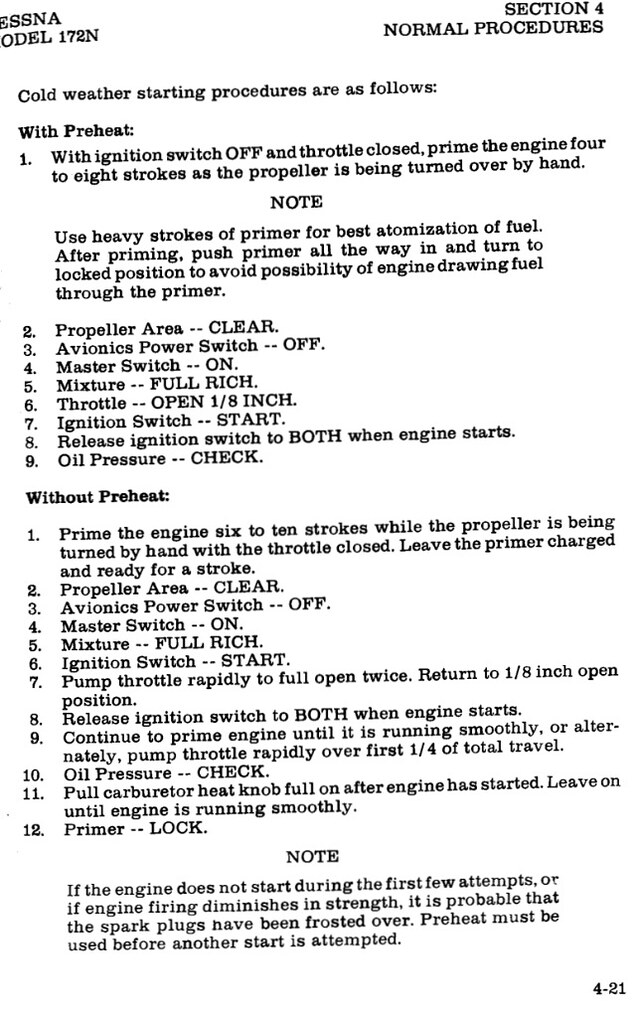 Press 4-8 times if preheated, or 6-10 times without preheat.
End