Propeller Metrics: Pitch and Blade Angle
In the FAA-H-8083-25A Pilot’s Handbook of Aeronautical Knowledge, there is the following explanation:
Propeller Pitch The pitch is defined as the distance a propeller would travel in one revolution if it were turning in a solid.
Blade Angle The angle of a propeller blade, as measured against the hub of the propeller, keeps the angle of attack relatively constant along the span of the propeller blade, reducing or eliminating the possibility of a stall. Blade angle, usually measured in degrees, is the angle between the chord of the blade and the plane of rotation and is measured at a specific point along the length of the blade.
1 Pitch and Slip
The function of the propeller is to produce thrust or negative thrust, driving the aircraft forward.
Pitch refers to the distance moved along the axial direction (by the propeller pulling the aircraft) after the propeller rotates one revolution around the axis in 3D space.
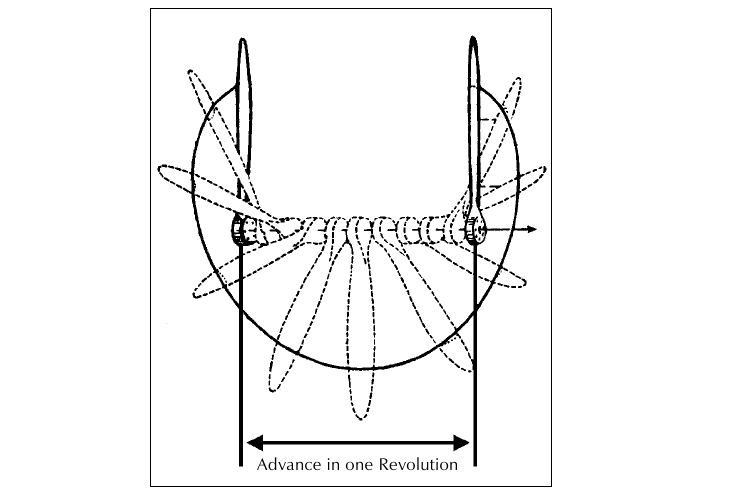
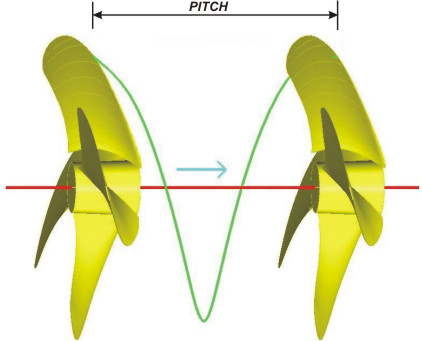 It may be difficult to understand literally, but looking at the figures above makes it easier to understand.
Actually, you can imagine the propeller as a nut threaded onto a bolt; when the nut rotates, it moves back and forth along the direction of the axis.
This distance is the pitch.
It may be difficult to understand literally, but looking at the figures above makes it easier to understand.
Actually, you can imagine the propeller as a nut threaded onto a bolt; when the nut rotates, it moves back and forth along the direction of the axis.
This distance is the pitch.
The back of many propellers is marked with a number indicating the pitch, and this unit is in inches. For example, for a propeller with a pitch of 74 inches, the movement distance after one revolution is 1.878 meters. 74 * 25.4 = 1879.6 mm = 1.88 m
Due to factors like Drag, the pitch (also called Geometric Pitch) is an ideal value, while the actual distance it can truly move is called Effective Pitch. For instance, I once saw a problem online: If the propeller speed is 1800 RPM and the aircraft speed is 540 km/h, what is the effective pitch of the propeller? A simple calculation: the movement distance per minute is 540 / 60 = 9 km, so the effective pitch is 9000 / 1800 = 5 meters. From this, we can also see that the factors determining flight speed are the propeller’s RPM and effective pitch.
The difference between the pitch and the effective pitch is called Propeller Slip.
The magnitude of the slip affects the amount of Thrust generated by the propeller,
reflecting the degree of compression of the medium flowing through it during the propeller’s operation.

If the propeller is marked “74-48”, it indicates its pitch is 74 inches and effective pitch is 48 inches.
2 Blade Angle and Angle of Attack
The Blade Angle is the angle between the chord line of the propeller blade and the plane of blade rotation, marked by a yellow arc in the figure below.

It is obvious that pitch and blade angle are two completely different concepts, but since the size of the pitch can basically be determined by the blade angle, people often use these terms interchangeably in reality. If the blade angle increases, the pitch also increases (called increasing pitch), and they are directly proportional.
Another angle can also be seen in the figure above, which is the Angle of Attack, marked by a green arc. The angle of attack is the angle between the blade chord line and the direction of the relative velocity of the air flowing over the blade. You should know that the angle of attack is the main factor affecting propeller efficiency, and the angle of attack that maximizes propeller efficiency is between 2 and 4 degrees.
Factors affecting the angle of attack include the blade angle, flight speed, and propeller RPM. When the blade angle and RPM are constant, an increase in flight speed decreases the angle of attack, and a decrease in flight speed increases the angle of attack. When the blade angle and flight speed are constant, an increase in RPM increases the angle of attack, and a decrease in RPM decreases the angle of attack.
End