Notes on Flying in Japan's Air Defense Identification Zone (ADIZ) Based on the Aeronautical Information Manual AIM-J
This week, the Air Defense Identification Zone (ADIZ) has become one of the hottest topics in China, Japan, and the US, following the issuance of relevant regulations by our government:
Statement by the Government of the People’s Republic of China on Establishing the East China Sea Air Defense Identification Zone Announcement of the Aircraft Identification Rules for the East China Sea Air Defense Identification Zone of the People’s Republic of China
I am not a military enthusiast, but since this topic is trending, I decided to check the Aeronautical Information Manual Japan (AIM-J) I have on hand to see what it says about the Air Defense Identification Zone and learn a bit.

Surprisingly, in this thick book, there are only 2 pages with relevant explanations. One is here,
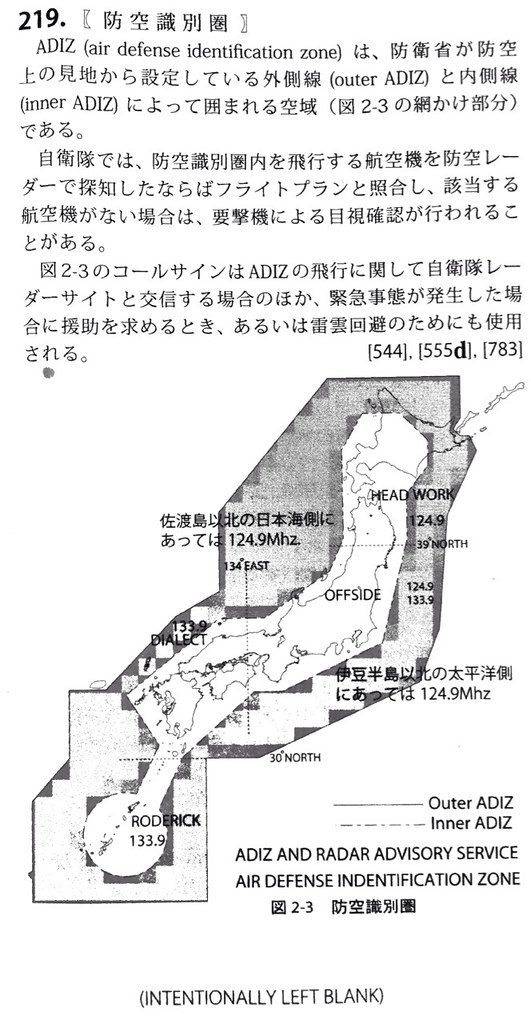 A map marks the location of the identification zone between the outer and inner lines, which is the shaded area. However, the map is small, and it’s hard to tell exactly how large the area is.
According to the explanation, if Japan Self-Defense Force radar detects an aircraft flying within the identification zone, they will check the flight plan.
If no information about the aircraft is found in the flight plan, they will scramble for visual identification.
The map also divides the identification zone into several sectors and publishes the call signs and frequencies for radio communication in each sector.
A map marks the location of the identification zone between the outer and inner lines, which is the shaded area. However, the map is small, and it’s hard to tell exactly how large the area is.
According to the explanation, if Japan Self-Defense Force radar detects an aircraft flying within the identification zone, they will check the flight plan.
If no information about the aircraft is found in the flight plan, they will scramble for visual identification.
The map also divides the identification zone into several sectors and publishes the call signs and frequencies for radio communication in each sector.
There is another section here,
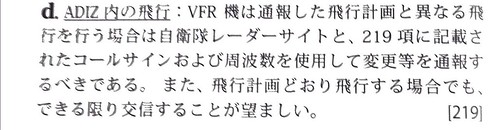 If the route during VFR flight differs from the flight plan, it is necessary to use the above frequencies and call signs to report to surveillance radar.
Additionally, even when following the flight plan, you should try to maintain contact with surveillance radar.
If the route during VFR flight differs from the flight plan, it is necessary to use the above frequencies and call signs to report to surveillance radar.
Additionally, even when following the flight plan, you should try to maintain contact with surveillance radar.
Hmm, that’s all the data there is. It looks like for a pilot, as long as you file a flight plan and actively maintain contact with radar, you are fine. Simple enough.
End