Setting Up a Discone Antenna (D130) for Aviation Band ATC Reception
Recently, in order to better receive Air Traffic Control,
I spent 12,000 yen (120 USD) to purchase a Discone antenna.
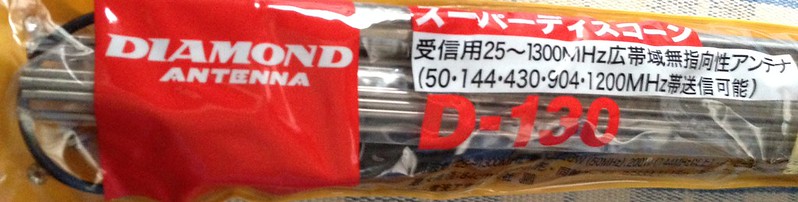 The results are quite satisfactory, and it has significantly improved radio reception.
This product model is the D130, manufactured by Diamond Antenna Corporation. It is an antenna with a very good reputation among aviation enthusiasts, recommended by many books and magazines. The reception frequency range of this antenna is very broad, covering from 25Hz to 1300MHz. However, the dimensions are large, with a height of 170 cm and a diameter of 84 cm, so it takes up a lot of space once installed. I racked my brains trying to find a place for it; I tried several spots on the balcony but couldn’t find a permanent home for it. Therefore, I temporarily decided to set it up every time I use it and put it away when I’m done.
A Discone antenna is a type of antenna with a rather unique shape.
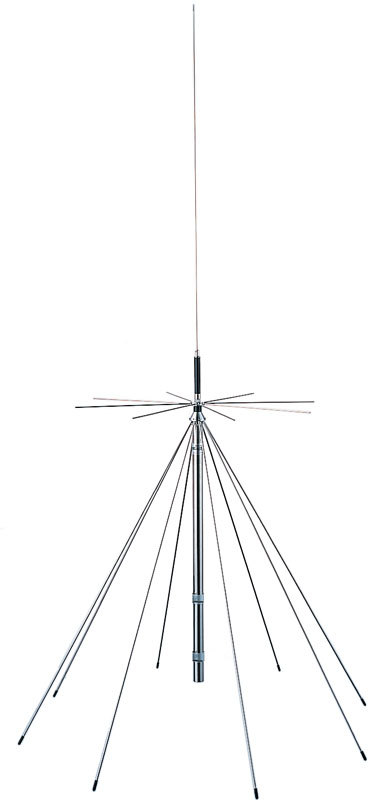 This is the manufacturer’s schematic for the D130. You can see that the antenna features three sections:
the top section is a standard rod antenna;
the middle section consists of 8 rod elements forming a disc antenna;
the bottom section consists of 8 rod elements forming a cone antenna.
This is the manufacturer’s schematic for the D130. You can see that the antenna features three sections:
the top section is a standard rod antenna;
the middle section consists of 8 rod elements forming a disc antenna;
the bottom section consists of 8 rod elements forming a cone antenna.
The Discone antenna is characterized by its wide bandwidth and omnidirectional pattern in the vertical plane. Therefore, for radio enthusiasts, purchasing just one Discone antenna basically covers common frequencies, making it economical and practical.
Below is a brief introduction to the installation method.
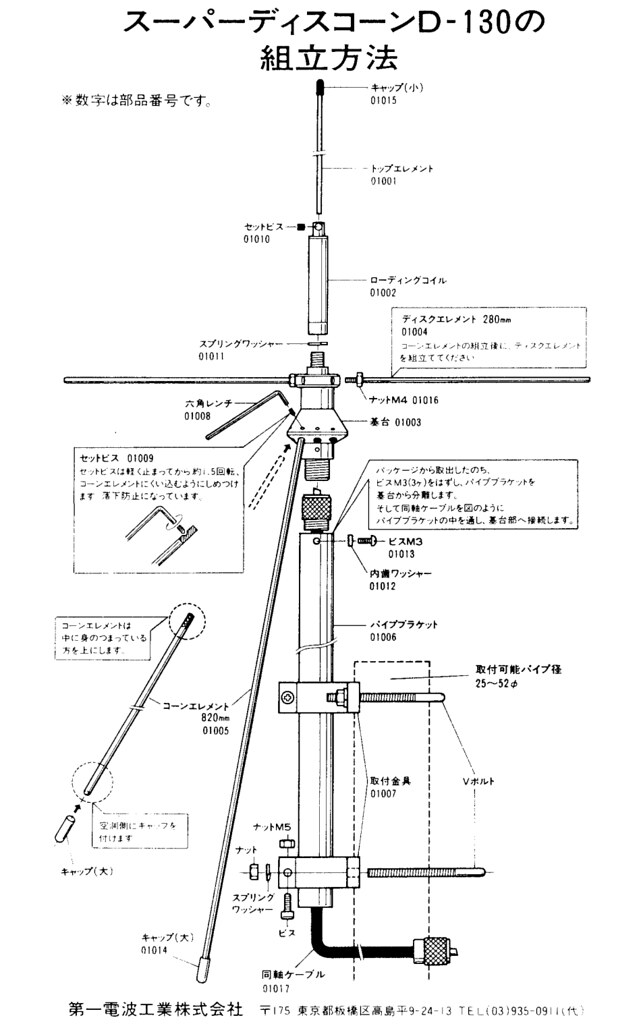 Since the assembly instructions provided by the manufacturer do not specify the order, looking at the manual alone might be a bit confusing.
Actually, you just need to remember the steps to assemble from the bottom up.
First, pass the coaxial cable through the mast and connect the antenna unit, then install the 8 lower cone elements,
then install the 8 middle disc elements, and finally install the top antenna element.
Since the assembly instructions provided by the manufacturer do not specify the order, looking at the manual alone might be a bit confusing.
Actually, you just need to remember the steps to assemble from the bottom up.
First, pass the coaxial cable through the mast and connect the antenna unit, then install the 8 lower cone elements,
then install the 8 middle disc elements, and finally install the top antenna element.
So, how is the actual performance? It is truly excellent. For example, when I previously used a 30cm long antenna to listen to Tokyo International Airport (Haneda Airport) Approach and Tower, the pilots’ voices were clear, but the controllers’ voices were very low with significant noise. Basically, I could only hear one side of the conversation. After using the D130, I can hear both sides of the conversation, and the noise has been drastically reduced. I can finally listen to complete ATC conversations.
Additionally, for frequencies I couldn’t receive at all before, such as Haneda Departure Delivery (Clearance Delivery), although the signal is weak and noise is high, I can now receive the signal. If I had a better desktop base receiver, it would probably be even clearer. (Time to start saving…)
Also, the Company frequency (Aircraft Operational Control) performance is impressive. For instance, when a plane flies from Haneda to Hokkaido, once it reaches the airspace over Tochigi and contacts Company, reporting cloud top height, turbulence, seatbelt sign status, estimated arrival time, etc., both sides of the conversation can be heard very clearly. At this point, the aircraft should be more than 150 kilometers away.
It truly confirms the ancient saying from the Analects, “Better tools make for better work” (sharpening your axe before you cut down a tree). To listen to ATC better, a good antenna is absolutely indispensable. (Especially for someone like me who lives relatively far from the airport.)
End