Principles and Usage of the Pressure Altimeter
Altimeter Barometer
1. The Altimeter requires Standard Atmospheric Pressure as a reference
The principle of the pressure Altimeter is based on measuring atmospheric pressure and converting that pressure into altitude readings. However, the relationship between atmospheric pressure and altitude is not simple enough to be expressed by a single formula. For example, the closer to the ground, the higher the air density; the higher from the ground, the lower the air density. Additionally, at the same atmospheric pressure, temperature changes have a significant effect on altitude. Therefore, it is impossible to obtain a reliable altitude figure solely from a pressure reading.
The solution to this problem is to define a specific set of weather conditions, known as the Standard Atmosphere. Under these conditions, the relationship between altitude, pressure, and temperature follows an approximately average distribution model.
Understanding this concept relative to the Standard Atmosphere explains why many people online question the accuracy of barometers or Altimeters.
The definition of the Standard Atmosphere is as follows:
- Temperature conditions At sea level, the temperature is 15 degrees. Below 11,000 meters, for every 1,000 meters increase in altitude, the temperature drops by 6.5 degrees. Above 11,000 meters, the temperature remains constant at -56.5 degrees.
- Pressure conditions Sea level pressure is one atmosphere, specifically 29.92 inches of mercury (inHg), 1013.2 hectopascals (hPa).
- Gravity conditions At latitude 45 degrees, g=9.8 m/s^2.
- Air composition The air contains no water vapor.
Under the Standard Atmosphere, the following conversion relationships between altitude, pressure, and temperature are obtained:
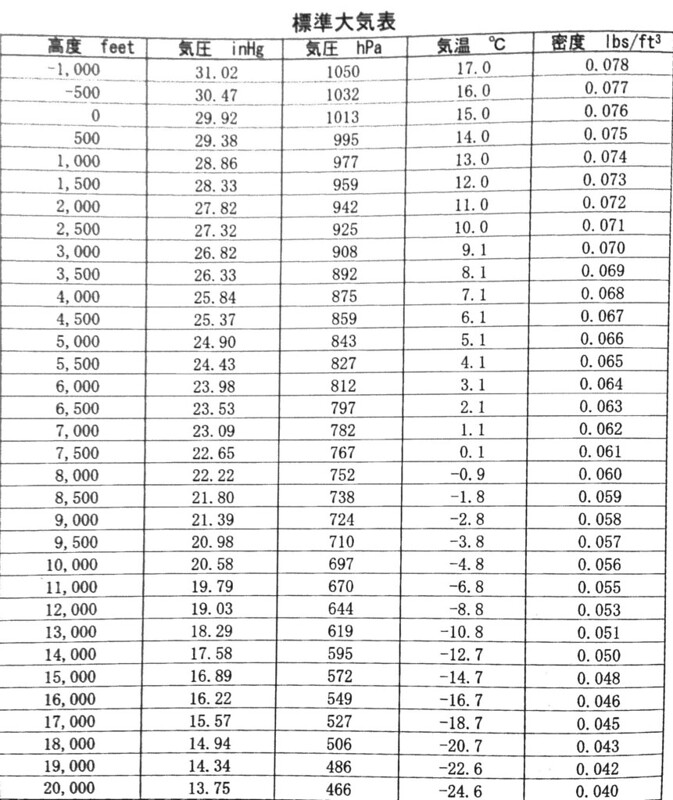 As an approximation, you can just remember: "For every 1,000 feet increase in altitude, atmospheric pressure decreases by 1 inch of mercury, and the temperature drops by 2 degrees Celsius."
With the Standard Atmosphere as a reference, the scale on the pressure Altimeter is manufactured based on the conditions above. For example, the scale is adjusted to 1,000 feet when the temperature is 13 degrees and the pressure is 28.86 inHg; or adjusted to 3,000 feet when the temperature is 9 degrees and the pressure is 26.81 inHg, and so on.
2. Why the Altimeter needs calibration
As long as the weather matches Standard Atmosphere conditions, the Altimeter reading can be considered the correct altitude. The problem is that in real life, such ideal weather does not exist. Therefore, it must be assumed that the reading of a pressure Altimeter will always have some error.
So the conclusion is, for the use of a pressure Altimeter, the instrument must be calibrated to obtain correct results!
However, we must also know that the purpose of using a pressure Altimeter is not to get a precise flight altitude value. Its real purpose is to ensure flight safety!
Since all aircraft flying in the sky use the same calibration value, the altitude separation between aircraft can be guaranteed: VFR eastbound aircraft use odd thousands of feet + 500 feet, VFR westbound aircraft use even thousands of feet + 500 feet. Everyone uses different altitudes, staggered by 1,000 feet from each other, which greatly reduces the risk of collision.
3. Calibrating for pressure
3.1 Kollsman window
Pressure Altimeters generally feature an “Altimeter setting window (Kollsman window)”.
 By adjusting the knob on the lower left, you can perform pressure calibration on the Altimeter.
So, what value should the calibration be set to? Generally, there are 3 pressure values available: QFE, QNH, and QNE. These 3 nouns are hard to remember because they are not abbreviations of words, but rather Morse code Q-codes used long ago, so you have to memorize them by rote.
3.2 QFE
“QFE” is the pressure at the airport field elevation. FE can be memorized as “Field Elevation”. If a pilot uses the QFE Altimeter setting to calibrate the Altimeter, the pointer on the Altimeter will point to 0 feet while at the airport.
The flight altitude of an aircraft set to QFE is called QFE altitude.
3.3 QNH
“QNH” is the corrected sea-level pressure. As the name implies, it corrects local barometer pressure to what it would be at sea level. NH can be memorized as “Not Here”. If a pilot uses the QNH Altimeter setting to calibrate the Altimeter, the pointer on the Altimeter in the aircraft will indicate the airport’s elevation above sea level (this is also the airport data marked on charts). Therefore, during takeoff, Climb, Descent, and landing near the airport, the Altimeter must be adjusted to the QNH standard. This ensures that all aircraft taking off and landing use the same standard to measure flight altitude, preventing accidents such as ground collisions, mid-air collisions, or near misses.
QNH can be obtained through Tower ATC, ATIS, METAR, etc. There are already many articles on this site introducing these, so I won’t go into detail here.
About ATIS Automatic Terminal Information Service What is ATIS like during a typhoon? METAR Aviation Routine Weather Report Format Summary Free Weather Information provided by NOAA
Pay attention to the relationship between pressure calibration and altitude indication. If the pressure calibration adjustment value is greater than the current setting value, the Altimeter indication will increase even if the flight altitude has not changed. Conversely, if the pressure calibration adjustment value is lower than the current setting value, the Altimeter indication will decrease even if the flight altitude has not changed.
Let’s take an example: flying from Tokyo to Osaka. Tokyo’s QNH is 29.92, Osaka’s QNH is 28.86. After calibrating to 29.92 in Tokyo and Climbing to a cruise altitude of 4,000 feet, if you arrive in Osaka without recalibrating, because Osaka’s pressure is lower than Tokyo’s, the Altimeter indication will gradually rise (because pressure is lower at higher altitudes). To maintain an indicated altitude of 4,000 feet, the pilot will gradually lower the aircraft’s altitude. Therefore, if not calibrated to the local QNH, the aircraft’s flight altitude will be lower than 4,000 feet, eventually reaching an altitude of 3,000 feet.
It is easy to imagine how dangerous this is. The pilot believes they are at an altitude of 4,000 feet, but the actual altitude is 3,000 feet. If the aircraft is flying at night or in clouds without seeing surrounding obstacles, and there is a 3,100-foot mountain ahead on the route, the aircraft will undoubtedly crash into the mountain. Similarly, if an aircraft flies from a high-temperature zone to a low-temperature zone, the Altimeter indication will be higher than the actual altitude, so pilots must pay close attention to their surroundings to prevent accidents.
Let’s look at what happens if the pilot adjusts the calibration after entering the Osaka information area.
After setting from 29.92 to 28.86, the flight altitude has not changed, but the instrument indication value becomes smaller.
To maintain an altitude of 4,000 feet, the pilot must add throttle and Climb to that altitude.
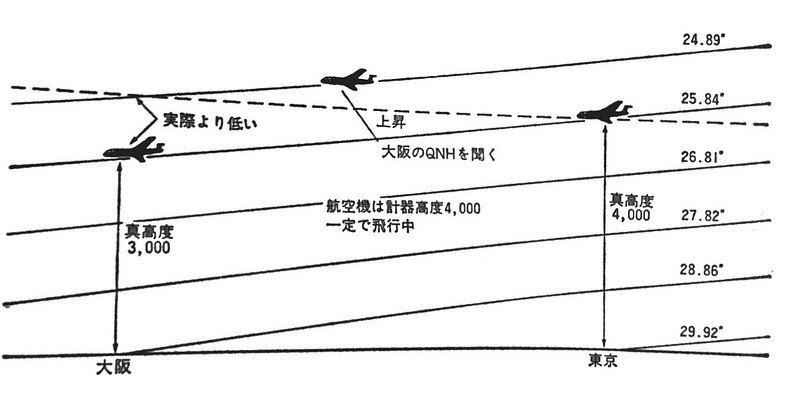
From the example above, it can be seen that the indication of a pressure Altimeter can only provide a relatively accurate altitude figure. During all stages of flight, pilots need to constantly calibrate and adjust flight altitude as needed.
3.4 QNE
“QNE” refers to the pressure at sea level under Standard Atmosphere conditions, with a value of 1013.2 hPa (29.92 inHg). There is really no good way to memorize QNE, just remember QFE and QNH, and the remaining one is QNE.
Near the airport, QNH can be used as the standard. However, when flying between airports, pressure changes are variable, and it is impossible to set up countless measurement stations on the ground or over the ocean to determine QNH. So if all aircraft uniformly use a standard, specifically QNE, in these situations, it simplifies Altimeter setting and ensures safety in the air.
So, under what conditions should QNH be adjusted to QNE? According to regulations, there is a Transition Altitude. When the altitude exceeds this height, the pilot needs to set the Altimeter to QNE, which is 29.92 inHg, 1013.2 hPa. Additionally, every country has different regulations for the transition altitude; for example, during Climb, China is 3,000 meters, Japan is 14,000 feet, the USA is 18,000 feet, the UK is 6,000 feet, and Singapore and Thailand are 11,000 feet. Sometimes you can see the “Altimeter setting changing line” on Japanese charts; when crossing this line, you need to adjust the transition altitude.
The instrument indication altitude corrected using QNE is called “Pressure Altitude (PA)”.
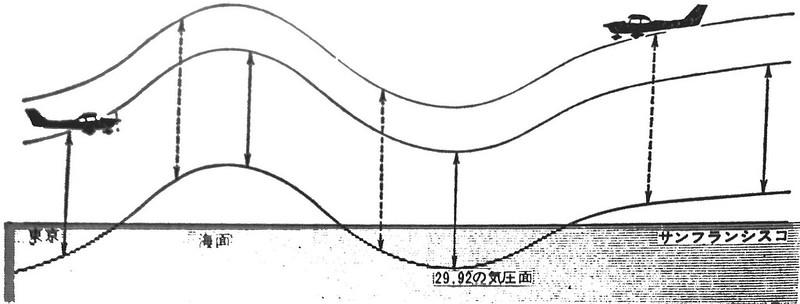
Under Pressure Altitude, due to pressure changes, the aircraft’s flight altitude is also constantly changing.
For example, flying from San Francisco to Tokyo, the aircraft’s actual altitude might fluctuate high and low as shown in the figure below,
but as long as all aircraft use the same 29.92 calibration value, their vertical separation is guaranteed,
thus ensuring flight safety.
4. How to know the actual flight altitude?
Generally speaking, using QNH altitude and Pressure Altitude (PA) is sufficient for small aircraft flight, but knowledge of how to calculate actual flight altitude and Density Altitude (which affects aircraft performance) is still necessary. Below, I will attempt to summarize this.
PA (Pressure Altitude) This is the QNE altitude mentioned above, i.e., the Altimeter indication when the calibration is set to 29.92 under standard atmospheric pressure conditions.
IA (Indicated Altitude) The value indicated on the Altimeter.
CA (Calibrated Altitude) The altitude value obtained after correcting IA for instrument error. Generally speaking, all mechanical/electronic instruments will have more or less error. For example, at an airport with an elevation of 100 feet, if the Altimeter indicates 120 feet after QNH setting, it can be considered that this Altimeter has a +20 feet error. This error can be adjusted during maintenance, but before returning to the shop for maintenance, as long as you add or subtract this error from the IA, you can continue to use the Altimeter. Therefore, the altitude obtained here after correcting for the error is the CA.
TA (True Altitude)
The actual flight altitude of the aircraft relative to sea level.
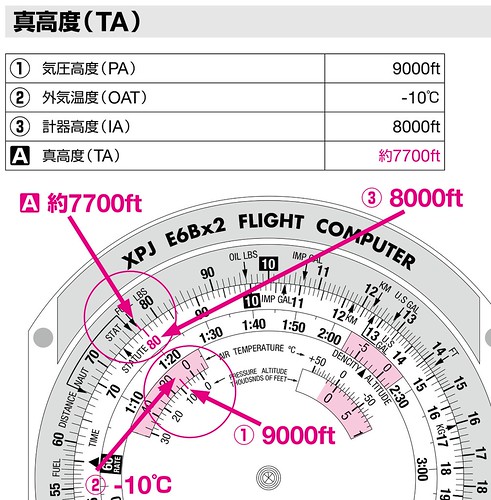
Generally speaking, small aircraft do not have an instrument that can directly measure True Altitude,
but it can be calculated by measuring PA and CA (or IA), and then using a flight computer (whiz wheel) based on the outside temperature.
DA (Density Altitude)
Density Altitude is the altitude value obtained after correcting PA for temperature.
Why do we need the Density Altitude metric? Because Density Altitude is used to calculate aircraft performance.
Many metrics in aircraft flight manuals or operating handbooks are based on Density Altitude,
so knowing this altitude is critical for pilots.
For example, a drop in temperature causes air to contract, increasing air density (lower Density Altitude), which increases aircraft performance.
Conversely, a rise in temperature causes air to expand, decreasing air density (higher Density Altitude), which reduces aircraft performance.
To calculate Density Altitude on a small aircraft, you first need to measure PA, and then calculate this value using a flight computer.
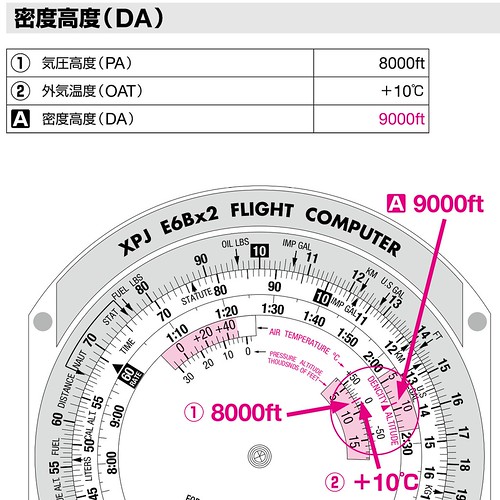
About flight computers: DIY Navigation Computer E6B A better free Navigation Computer E6B DIY model E6B app on iOS – iE6-B
End
A plagiarizer who didn’t say hello http://blog.163.com/congrashino@126/blog/static/1209258120146164356850/
Updated on 2018/04/19 Regarding the effect of temperature on pressure Altimeters, here are two related articles Analysis of the current status of civil aviation low-temperature correction in China
The impact of low temperatures on aircraft operation cannot be underestimated, whether in the departure phase, cruise, Descent, approach, or go-around phase, there are more or less effects. Especially in the final approach phase, where the flight altitude gets lower and lower in preparation for landing, if the safety margin does not meet requirements, it is extremely likely to trigger a Ground Proximity Warning System (GPWS) or cause a Controlled Flight Into Terrain (CFIT).Experts have used the collision model from ICAO 8168 (Visual and Instrument Flight Procedures Design) to calculate that under extreme low-temperature conditions at a certain airport, if an aircraft flies according to procedures without low-temperature correction for the pressure Altimeter, the collision probability is about 10^-4, whereas the acceptable collision probability according to regulations is 10^-7. Thus, the collision probability of the aircraft increases by a staggering 1,000 times compared to operations under normal temperature conditions.