Various Speeds
Vs0 -- The stall speed or minimum steady flight speed in the landing configuration. In small aircraft, this is the power-off stall speed at maximum landing weight in the landing configuration (gear and flaps fully deployed). The lower limit of the white arc on the Airspeed Indicator.
Vfe -- The maximum speed with flaps extended.
Vs1 -- The stall speed or minimum steady flight speed obtained in a specific configuration. For most aircraft, this is the power-off stall speed at maximum takeoff weight in a clean configuration (gear retracted, and flaps retracted if retractable). The lower limit of the green arc on the Airspeed Indicator.
Vno -- Maximum structural cruise speed (exceeding this speed may cause structural stress overloading on parts of the aircraft). Do not exceed this speed unless in smooth air. The upper limit of the green arc on the Airspeed Indicator.
Vne -- Never-exceed speed. Operation above this speed is prohibited as it may cause damage or structural failure.
Design Maneuvering Speed Va -- This is the maximum speed for turbulence and abrupt control movements. If you encounter turbulence or severe instability during flight, reduce airspeed to maneuvering speed or below to minimize stress on the aircraft structure. It is important to reference this speed considering weight. For example, Va might be 100 knots when the aircraft is heavily loaded, but only 90 knots when lightly loaded.
Landing Gear Operating Speed Vlo -- If the aircraft is equipped with retractable landing gear, this is the maximum airspeed for extending or retracting the landing gear.
Landing Gear Extended Speed Vle -- The maximum airspeed at which the aircraft can safely fly with the landing gear extended.
Best Angle of Climb Speed Vx -- The airspeed at which the aircraft can gain the maximum altitude in a given distance. This speed is used during short-field takeoff to clear obstacles.
Best Rate of Climb Speed Vy -- The airspeed at which the aircraft can gain the maximum altitude in a given time.
Minimum Control Speed Vmc -- Velocity of Minimum Control. Also known as minimum controllable speed or minimum control speed. This is the airspeed at which a twin-engine aircraft can be adequately controlled when one engine suddenly fails, while the other engine is at takeoff power.
Velocity of Minimum Control on Ground Vmcg -- Velocity of Minimum Control on Ground. During the takeoff ground acceleration roll, if an engine fails, this is the most critical minimum speed needed to know that the aircraft can maintain control. In this situation, the rudder pedals (controlling the rudder) must be used to balance yaw, counteracting the power imbalance caused by the failed engine. “Controllable” is defined as maintaining the wings level, keeping the taxi direction, lateral deviation from the runway center less than 9 meters / 30 feet, and rudder control force less than 68 kg. Vmcg depends on engine power and density altitude. If a failure occurs before the aircraft accelerates to Vmcg, the takeoff should be aborted immediately.

Takeoff Decision Speed V1 -- Decision Speed. The maximum speed at which the takeoff must be aborted when an emergency occurs. Above speed V1, since effective braking distance on the runway cannot be guaranteed, the aircraft must continue the takeoff. V1 should be greater than Vmcg to ensure the aircraft is controllable.
Velocity of Minimum Unstick Vmu -- Velocity of Minimum Unstick. This refers to the speed at which the aircraft can become airborne and continue the takeoff without exhibiting any dangerous characteristics. At and above this speed, with all engines operating or with one engine inoperative, the aircraft can safely lift off and continue the takeoff without the danger of tail-strike. Vmu is determined by the aircraft fuselage attitude angle when the tail scrapes the ground, and is verified through ground takeoff tests (as shown below). Minimum unstick speed is related to the aircraft’s thrust-to-weight ratio (aircraft weight and all engines operating or one engine inoperative) and the aircraft’s configuration; the one-engine-inoperative scenario is more critical.
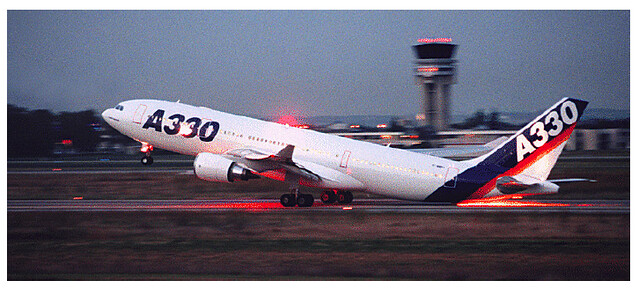
Takeoff Rotation Speed VR -- Rotation Speed. The takeoff rotation speed ensures that even with one engine failure, the aircraft can become airborne normally and can accelerate to above V2 speed (or equal to V2 speed) at 35 feet altitude. The rotation speed must be greater than or equal to V1 and Vmu.
Velocity of Minimum Control in the Air Vmca -- Velocity of Minimum Control in the Air. Similar to Vmcg, Vmca is the minimum speed at which the aircraft can maintain control in the air. The definition of controllable in the air is that after one engine fails, the aircraft can maintain straight flight, the bank angle towards the operating engine does not exceed 5°, and the rudder force does not exceed 180 pounds or the rudder is fully deflected (conversely, if the rudder pedal is pressed to the limit and the aircraft still cannot maintain balance, it cannot be called controllable).

Takeoff Safety Speed V2 -- Takeoff Safety Speed. V2 is the minimum speed for single-engine Climb that must be reached at a height of 35 feet at the end of the takeoff when one engine fails at speed V1 or greater. V2 should be at least 20% greater than the stall speed and 10% greater than the Velocity of Minimum Control in the Air (Vmca). V2 ensures the aircraft can achieve the minimum required Climb gradient and guarantees the aircraft is controllable. With all engines operating, a speed of V2+10 can achieve better climb performance.
Best Rate of Climb Speed with Single Engine Failure Vyse -- In a twin-engine aircraft with one engine failed, the airspeed that allows for maximum altitude gain in a given time.
Minimum Control Speed during Approach and Landing with All Engines Operating Vmcl -- Minimum Control Speed during Approach and Landing. Vmcl is the calibrated airspeed at which, when the critical engine suddenly fails, control of the aircraft can be recovered with that engine remaining inoperative, and zero yaw or straight flight with not more than 5 degrees of bank can be maintained.
Reference Stall Speed Vsr – In a set configuration, the minimum stable flight speed that can be maintained controllably is the stall speed of that aircraft. The manufacturer defines Vsr as the 1G stall speed in a specific configuration, which changes according to different aircraft weights.
Final Takeoff Speed Vfto -- The speed reached at the end of the takeoff phase after the aircraft has taken off with a single engine failure and completed retraction of the configuration.
Airspeed Indicator
White Arc -- This arc usually refers to the flap operating range; its lower limit indicates the stall speed with full flaps, and the upper limit indicates the maximum flap speed. Approach and landing are typically flown within this white arc speed range.
Green Arc -- This is the aircraft’s normal operating speed range. Most flight occurs within this speed range.
Yellow Arc -- Caution range. Flight in this speed range is permitted only in smooth air; it serves as a warning only.
Red Line -- Never-exceed speed.
References: Airbus Safety Library - Takeoff and Departure Operations Understanding Takeoff Speeds 737 Takeoff Performance Airbus Performance Introduction