Photography Notes at Kobe Airport
There are three major airports in the Kansai region of Japan: Kansai International Airport, Osaka International Airport (Itami Airport), and Kobe Airport. I had already been to the first two, so recently, taking advantage of a business trip, I used Kobe Airport to return to Tokyo. I also took some photos at the airport, effectively marking all three Kansai airports as visited.
Since my flight was scheduled for 18:00 that afternoon, I spent the morning wandering around the city, had lunch in Chinatown, took a walk by the seaside and in the beautiful city of Kobe, and started preparing to head out around 15:00.
The main public transport means to the airport is the elevated train “Portliner,” which departs from Sannomiya Station in the city center.
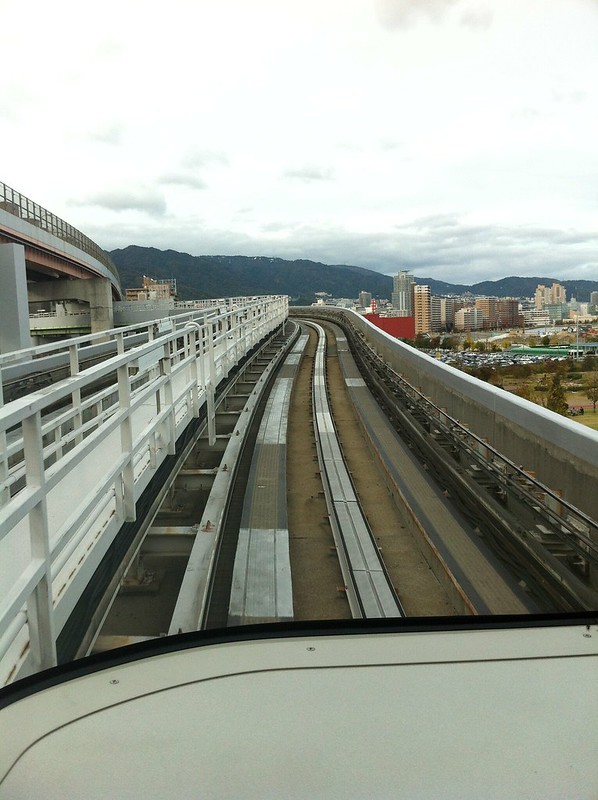 About 10 minutes later, the sea comes into view.
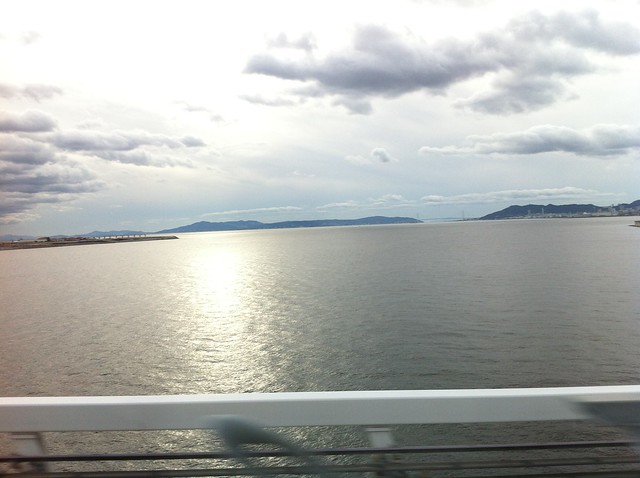
Kobe Airport is built on reclaimed land.
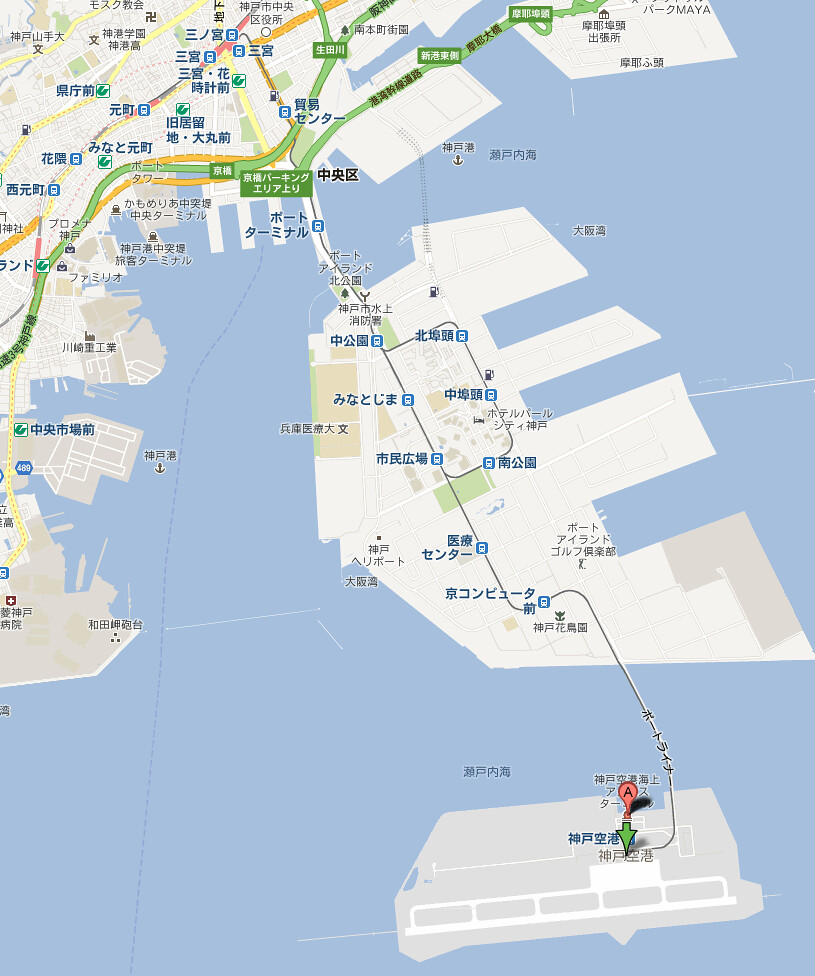 As you can see from the Google Maps screenshot above, the airport is located at the very bottom of the image and is an artificial island.
By the way, this airport is quite special because it is managed by the City of Kobe. It was constructed and is operated entirely by the Kobe municipal government itself. It opened on February 16, 2006, with the airport code RJBE. This airport is relatively small, with only two airlines operating routes: All Nippon Airways (ANA) and Skymark Airlines. There is only one 2,500-meter Runway, but it can handle large domestic airliners like the Boeing 777. There are only 10 aircraft parking gates in total. The observation deck on the 3rd floor of the terminal offers a panoramic view of the Apron and the Runway.
After the elevated train crosses this sea bridge,
 it arrives at the terminal station, Kobe Airport.
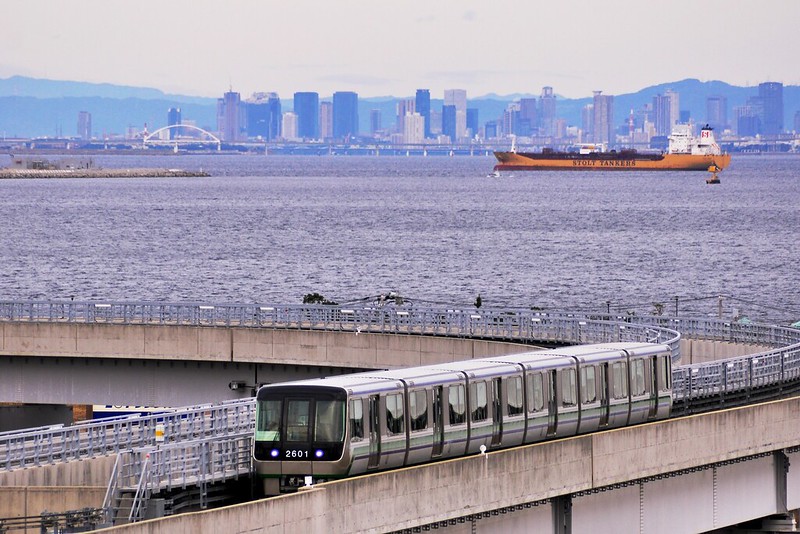
The photo below shows the elevated train “Portliner”.
The photo was taken at the Kobe Airport Terminal, where you can see the skyscrapers of Umeda in downtown Osaka in the distance.
I went straight up to the observation deck on the 4th floor after leaving the station, just in time to catch this rare “Mohawk” livery aircraft being pushed back!
(This was taken with an iPhone, so the image quality is a bit lower)
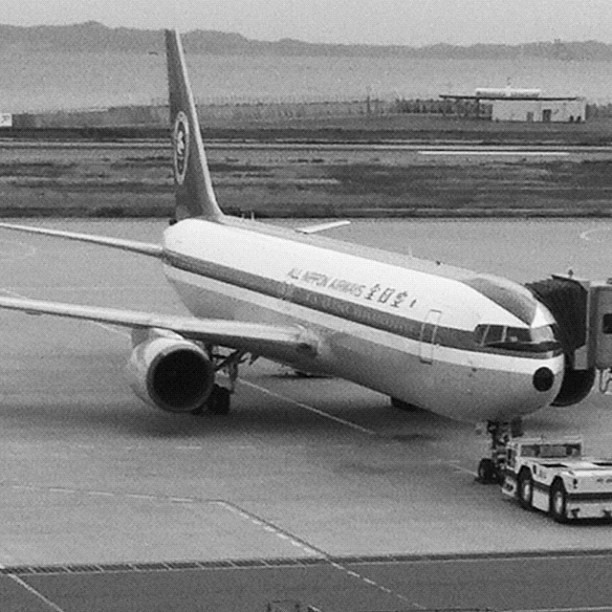
This ANA 767-300 JA602A livery is called “Mohawk,” a special retro livery. The Mohawk was a popular hairstyle in the hippie culture of the 60s, also known as a mohawk haircut. ANA used this livery when they introduced the 737-200 in 1969. Later, to commemorate this design, it was reintroduced on this 767 in 1999. In Japanese, it is called “Mohawk Jet,” and it is very popular.
Then I watched it enter the Runway,
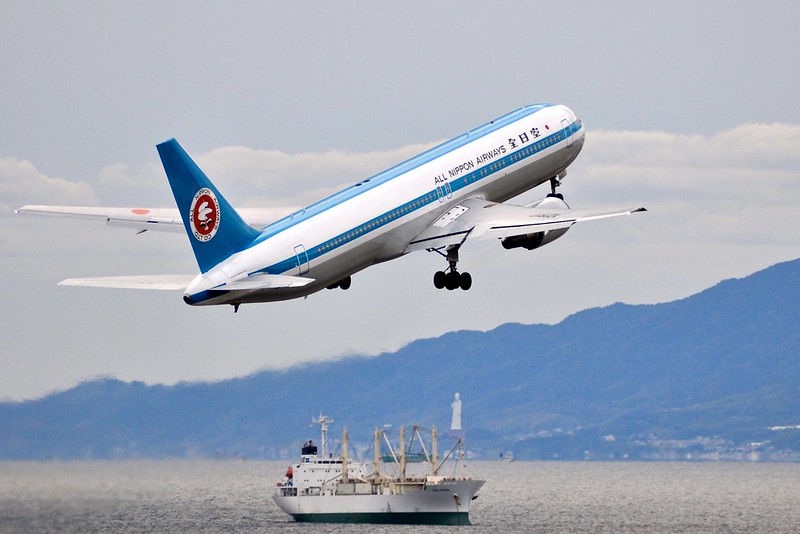
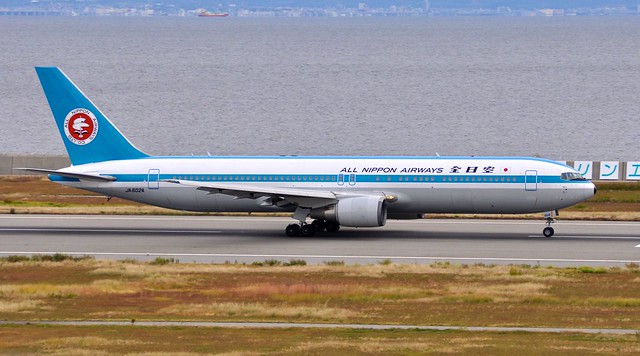 accelerate for Takeoff and Lift Off,
 flying westward.
By the way, the main aircraft at Kobe Airport are from Skymark Airlines,
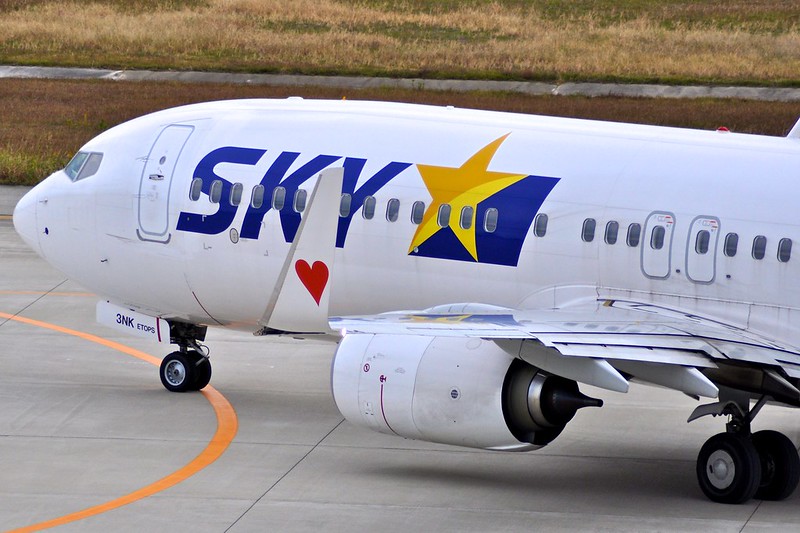 Skymark Airlines is a Japanese low-cost carrier operating a fleet of 15 brand-new Boeing 737-800s.
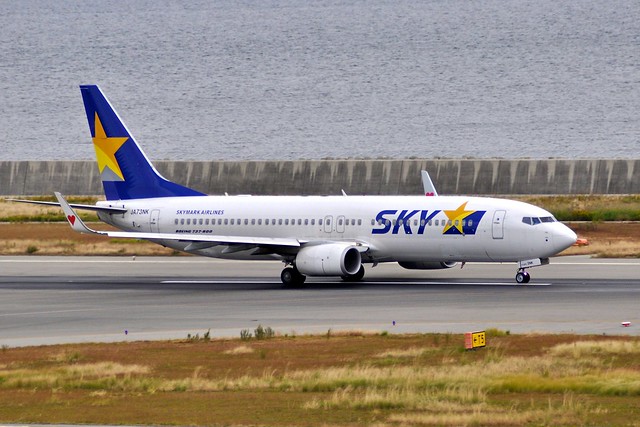 I watched from the observation deck for an hour and a half, and it was mostly this airline’s flights coming and going.
They were in a rush, too; after landing, they would take off again in less than 30 minutes after refueling, cleaning, and boarding passengers.
It truly is a busy airframe.
I watched from the observation deck for an hour and a half, and it was mostly this airline’s flights coming and going.
They were in a rush, too; after landing, they would take off again in less than 30 minutes after refueling, cleaning, and boarding passengers.
It truly is a busy airframe.
But compared to that 767 earlier, I wonder why this 737 used such a long Takeoff roll distance on the Runway?
Watching it迟迟 not pull its nose up, I thought there was a malfunction at the time. To compare,
Skymark’s 737-800:
 ANA’s 767:
As it gradually got dark, it became increasingly difficult to photograph aircraft Landing from the west over the Akashi Kaikyo Bridge,
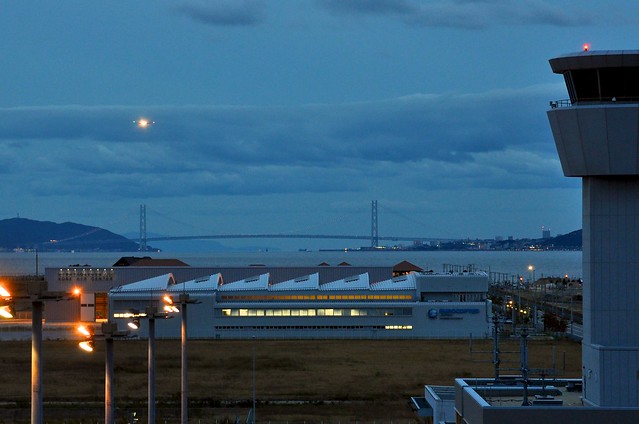 I barely managed to get a few shots without too much camera shake.
Fortunately, the 767 coming from Tokyo to pick me up finally arrived,
I barely managed to get a few shots without too much camera shake.
Fortunately, the 767 coming from Tokyo to pick me up finally arrived,
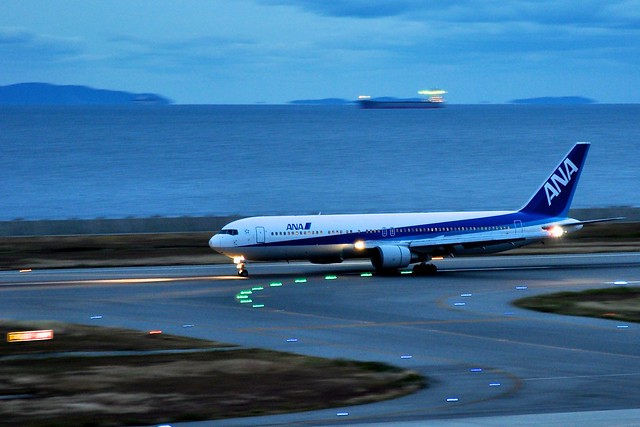
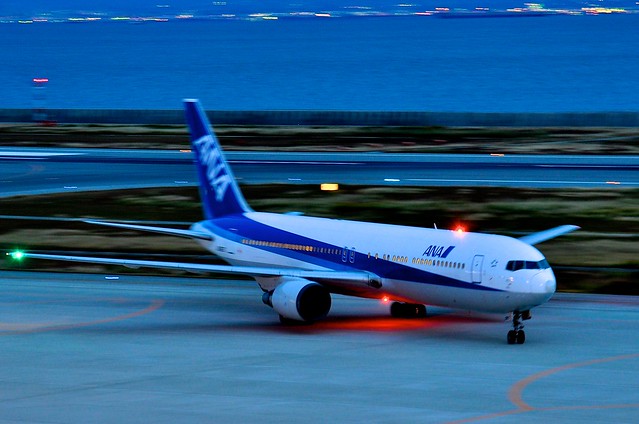 I went downstairs to check in and boarded for home.
The night view on the evening flight was wonderful, especially when flying over Kyoto and Nagoya.
I couldn’t help but stand up, take my camera out of my suitcase, and snap a few photos.
The interior of this 19-year-old ANA 767 was maintained perfectly; it was incredibly clean and touching.
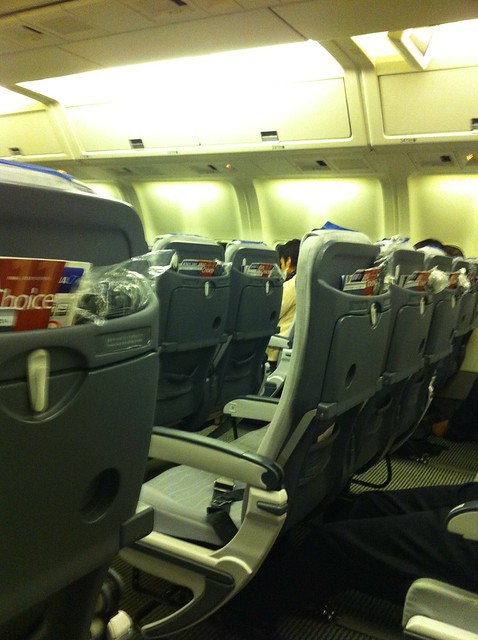
The flight attendants were beautiful and smiling like flowers; I really lucked out today.
The only unpleasant part was a kid who kept crying the whole way from the moment we boarded, which ruined my mood for taking notes. However, the effects of my hard practice on flight simulation kicked in, and even in the pitch dark, I could roughly tell where we were based on just a few lights on the ground. The accuracy of X-Plane’s world terrain database is truly impressive.
I am quite familiar with this route segment: Takeoff from Runway 27, Turn east after passing Akashi, via Kyoto-Gifu-Nagoya-Hamazu-Izu Peninsula-Oshima-Chiba, and Land on Runway 34L at Haneda. Booking a window seat on the left side in advance was absolutely the right choice.
After arriving at Haneda Airport, I passed by this 787,
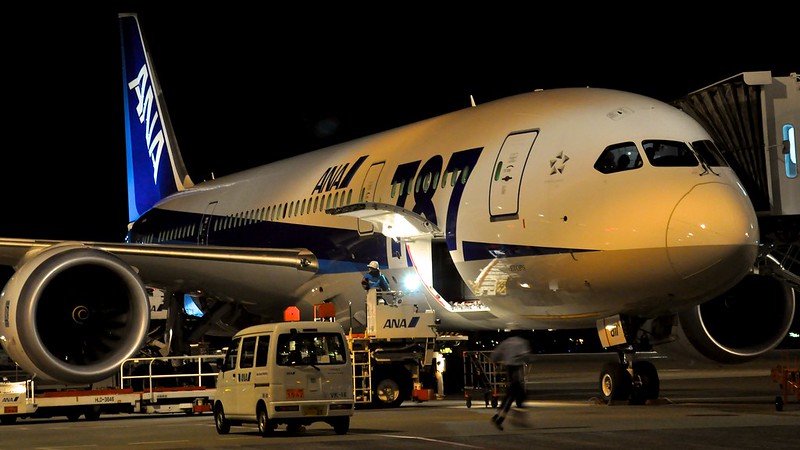 Upon closer inspection, the registration number reveals that it is an aircraft I have flown on before.
It seems I have a connection with it after all.
Upon closer inspection, the registration number reveals that it is an aircraft I have flown on before.
It seems I have a connection with it after all.
End