Title: Exploring the Cockpit of Airliners 4.4 About Cruise Altitude
Generally speaking, the cruise altitude for short-haul domestic flights remains constant. As mentioned in previous sections, after entering the cruise phase, the aircraft maintains this altitude until the Descent and landing, barring severe weather or emergencies. However, for long-haul international routes, particularly over oceans, “Step Climb” is often employed—a method of gradually increasing the cruise altitude. Let’s look at an example of a Boeing 777-300ER flight from Tokyo to New York to see how altitudes are scheduled.
Considering fuel economy, aircraft are more fuel-efficient at higher altitudes than at lower ones. However, on long-range routes, the fuel load is significantly higher than on short-range ones. Climbing to a high cruise altitude at a high angle of attack while heavy can actually decrease fuel economy. For any given weight, there is an optimal altitude. As fuel is consumed and weight decreases, the aircraft gradually climbs to higher altitudes based on the optimal altitude for that specific weight to achieve the best economy.
In the example below, this Boeing 777 has a takeoff weight of 343 tons. 20 minutes after takeoff, it first climbs to 31,000 feet for Level Flight because this altitude offers the best economy for the current weight. After 2 hours and 50 minutes, it climbs to 32,000 feet. After flying at 32,000 feet for 1 hour and 10 minutes, the aircraft’s weight drops to 298 tons, and it climbs to 33,000 feet. After cruising at 33,000 feet for nearly 4 hours, the weight drops to 266 tons, prompting another climb to 37,000 feet. At 37,000 feet, although the destination is close and the flight lasts only a short 40-plus minutes, the overall fuel economy of the trip remains excellent.
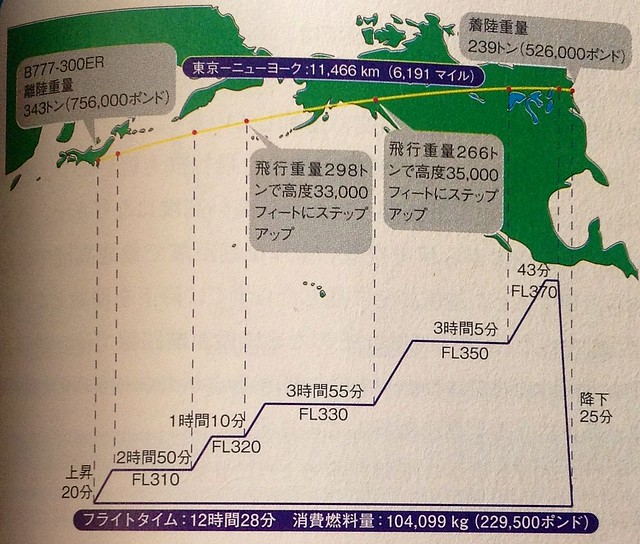
As seen in the chart above, using the step climb method resulted in a flight time of 12 hours and 28 minutes with a fuel consumption of 105 tons. This saved 2 minutes of flight time and 1.7 tons of fuel compared to maintaining a constant cruise at 31,000 feet.
In the future, when you travel by air, pay attention to the engine sound. If the engine noise suddenly increases for a minute or two, it is likely the pilot adjusting for a Step Climb. It is a good habit to watch the altitude display on the in-flight entertainment system and record it periodically.
Short-haul flights (such as from Tokyo to Osaka, taking less than an hour) also face issues regarding altitude and fuel economy. While the fuel load is smaller, making it easier to reach higher altitudes, the destination is so close that climbing to altitudes with lower air resistance is immediately followed by the need to Descend. Consequently, the overall fuel consumption is not worthwhile. Therefore, a cruise altitude must be selected that minimizes total fuel consumption, taking into account the Climb, Descent, and cruise phases.
Relatively longer routes can utilize higher altitudes, but one must sometimes be aware of the Jet Stream.
The Jet Stream consists of several strong, narrow bands of high-speed winds that encircle the globe, concentrated in the tropopause or stratosphere. They occur in the westerly winds of mid-to-high latitudes or in low-latitude regions. They can stretch horizontally for thousands of kilometers, be hundreds of kilometers wide, and several kilometers thick. Wind speeds at the core can sometimes reach 200 to 300 km/h. Flying against the flow at high altitude is like “sailing against the current,” significantly reducing the aircraft’s ground speed, while flying with it significantly increases speed. Therefore, flights from Asia to North America and Canada often route through these jet streams to shorten distance and save fuel, while return flights may take the Arctic route. Domestic Japanese routes also utilize this airflow; for example, winter flights from Tokyo Haneda to Fukuoka may choose lower altitudes to avoid the jet stream. Here, the opposing wind speed is approximately 100 km/h, much lower than the 300 km/h speed found at higher altitudes. Naturally, the return flight will utilize high-altitude flight to take advantage of the wind.