Title: A Brief Discussion on the Use of Mixture Control in Small Aircraft
As altitude increases, the air becomes thinner, reducing the amount of air entering the engine.
If the amount of fuel delivered remains constant, the fuel mixture becomes too rich, which not only wastes fuel but also reduces engine output.
This is where the Mixture Control valve comes in; it allows pilots to control the air-to-fuel ratio, giving you more precise control over the engine.
This magical valve is the red handle indicated by the red arrow in the image below (Cessna 172SP in X-Plane 10).
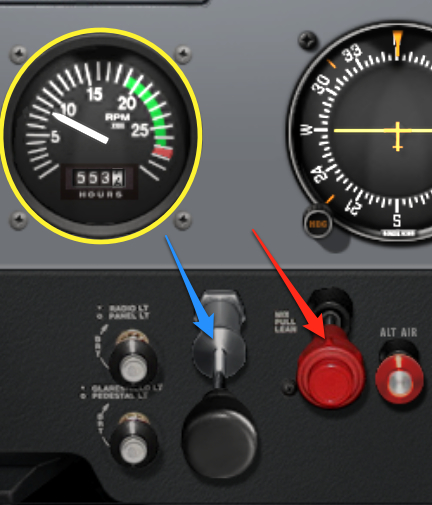
Pushing this valve forward increases the fuel flow to the engine; this is called RICH. When pushed all the way in, the setting is typically calibrated for Level Flight at sea level. Pulling the valve back reduces the fuel supply; this is called LEAN. If pulled all the way out, the fuel supply is cut off completely, causing the engine to stop.
Separately, the valve that controls the total amount of the fuel-air mixture entering the engine is the Throttle, indicated by the blue arrow in the image above—what we commonly call the “gas pedal.”
Here is a brief guide on using the Mixture Control.
Generally, above 2,000–3,000 feet, the air becomes thin enough to affect engine performance. So, once you Climb to this altitude, you can pull the Mixture back slightly to LEAN it and restrict the fuel flow.
An even simpler method is to slowly pull the Mixture Control back. As the fuel supply decreases, the RPM indication on the Tachometer (yellow circle in the image above) will slowly rise. However, past a certain point, the fuel flow becomes too lean, and the needle will start to drop. Therefore, the Mixture setting where the RPM is at its maximum is the most efficient setting. Note here that to prevent engine overheating, pilots generally use a slightly richer mixture than the peak RPM setting—that is, set it to be slightly RICH.
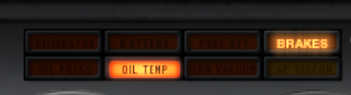
If the engine overheats, you will see the following OIL TEMP warning message.
Of course, during flight, you must regularly scan the EGT Gauge (Exhaust Gas Temperature Gauge) below.
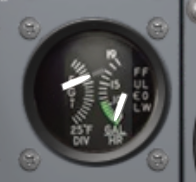 The left needle indicates exhaust gas temperature (EGT). If it is too high (needle pointing up/right), enrich the mixture with the Mixture Control (make it RICH). The right needle shows fuel flow; you can refer to the aircraft’s performance manual to check flow values at various altitudes.
Also, keep in mind that a mixture setting leaned for cruise altitude becomes too lean for ground operations. Therefore, never forget to enrich the mixture (make it RICH) during Descent and landing, especially during a Go Around or Missed Approach.
Also, when taking off from high-elevation airports, due to the thin air, do not forget to adjust the Mixture beforehand (LEAN it).
End