Inside the Cockpit 2.4 Ground Taxiing Taxi
The aircraft is pushed by the tug to the end of the Apron, and the ground crew contacts the flight deck again:
Ground Crew: “Flight deck, set parking brake.”
Captain: “Brakes set.”
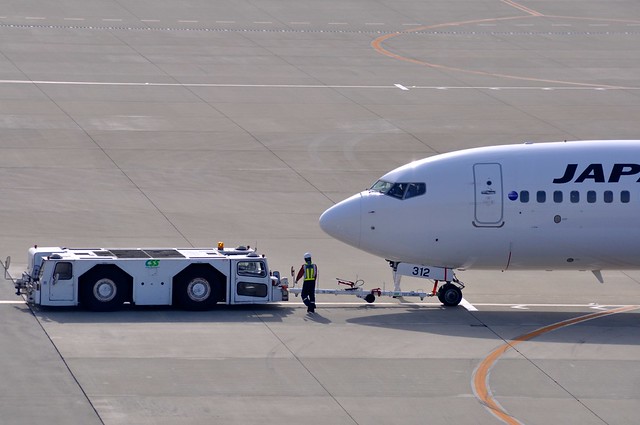 Consequently, the ground crew removes the tug’s tow bar from the nose landing gear, sets the wheel chocks again,
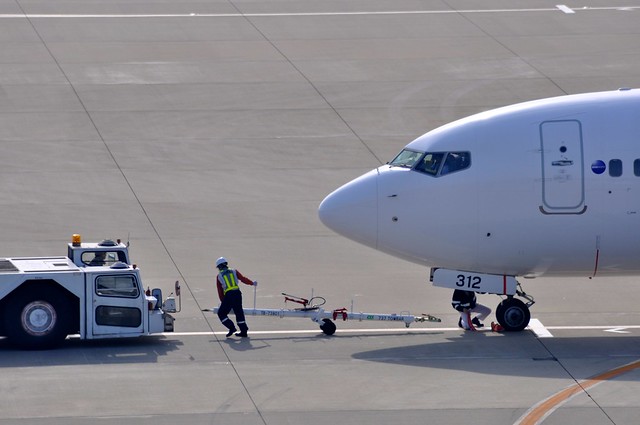 and the tug moves away from the aircraft.
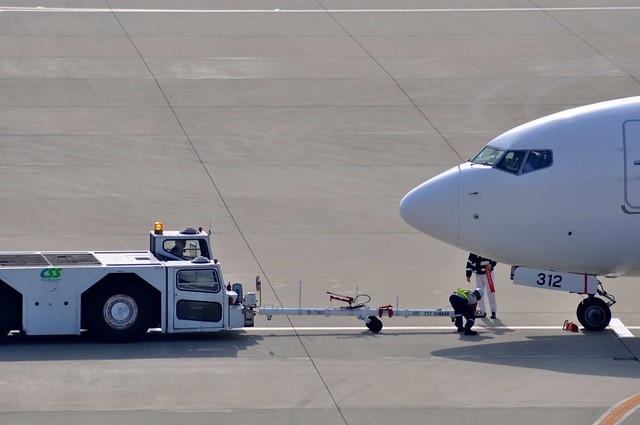 (Photo above taken at Chubu Centrair International Airport)
The First Officer monitors the EICAS, confirms that the left and right engines are running stably, reports to the Captain, and then executes the after-start checklist (taking the Boeing 737-500 as an example).
 For instance, setting the engine anti-ice system to AUTO, etc. Once everything is normal, the Captain contacts the ground crew waiting on the ground again:
Captain: “Ground, engine start complete, disconnect communication cable.” Ground Crew: “Chocks removed, landing gear safety pins removed, cable disconnected.”
(The landing gear safety pin is used to prevent accidental retraction of the landing gear. It must be inserted whenever the aircraft is on the ground so that accidental retraction will not damage the aircraft.)
After removing the chocks, the ground crew’s work is done. They leave the aircraft and line up in a row, waving to the departing aircraft to salute it. The pilots also wave through the aircraft window to express their gratitude for their hard work.
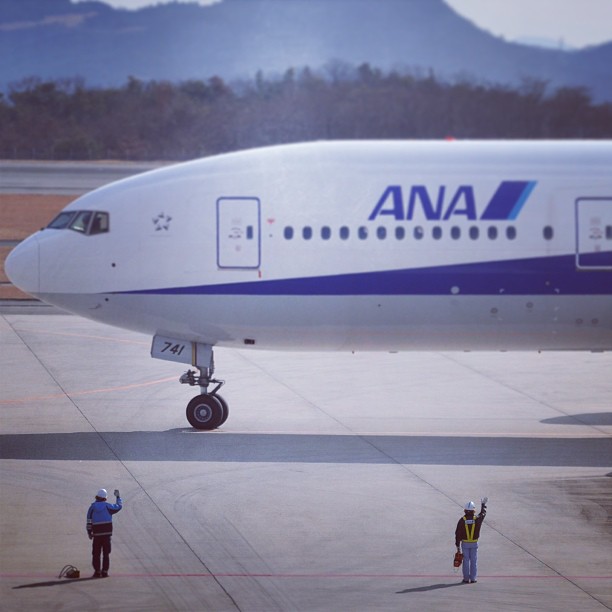 (Photo above taken at Hiroshima International Airport)
The aircraft can finally move under its own power. The First Officer contacts the airport Ground Control:
“Ground, Air System 115, request taxi.”
This means: “Ground Control, this is Air System 115, requesting taxi.”
The Ground Controller will inform the aircraft whether it can move or needs to wait based on congestion and weather conditions at the airport. If there are no issues, they will approve the taxi and provide the taxi route:
“Air System 115, Taxi to Runway 16R, Via P3 J2 W2 outer.”
This means: “Air System 115, taxi via P3 J2 W2 outer to Runway 16R.”
The pilot then repeats: “Runway 16R, P3 J2 W2 outer, Air System 115.”
I.e.: “Runway 16R, P3 J2 W2 outer, Air System 115.”
The aircraft uses the Taxiway to move from the Apron to the Runway. Taxiways are identified by one or more continuous yellow center lines and are named with English letters, such as Taxiway A, Taxiway C, etc.
The P3 J2 W2 mentioned above are signs for runway exits within the airport. At large airports like Haneda, the taxi from the Apron to the end of the Runway usually covers a long distance. Pilots must strictly follow the route instructed by ATC. The taxi route is composed of some waypoints/signs. Pilots must consult the airport charts to confirm the route before starting to taxi.
You can see what the signs look like in the photo below. This photo of the waiting point A2 for entering Runway 24L was taken by me at Kansai Airport:
 There are several types of signs at the airport, and their meanings can be distinguished by their colors:
- Black background with yellow letters: Location sign. “A2” in the photo above is a location sign.
- Red background with white letters: Mandatory instruction sign, indicating entry into a Runway or a prohibited area. The “24L” in the photo above indicates imminent entry into Runway 24L.
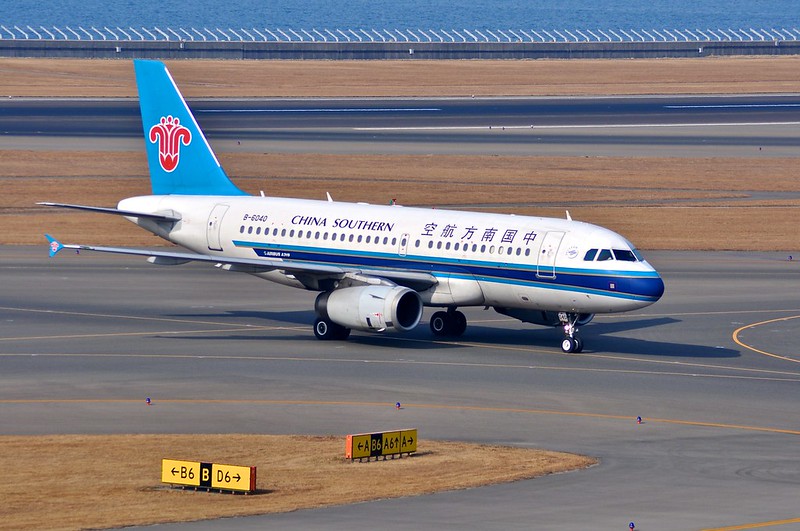
- Yellow background with black letters: Direction sign and destination sign. For example, the “B6 B D6” at Nagoya Centrair Airport in the photo below indicates: from the current B Taxiway, turn left to point B6, turn right to point D6; the “A B6 A6 A” sign indicates that when arriving at this B6 sign from the Taxiway at the bottom right of the photo (i.e., when positioned directly opposite the aircraft in the photo), there will be three yellow lines on the ground: follow the left turn line to enter Taxiway A on the left, go straight to reach point A6, or turn right to enter Taxiway A on the right.
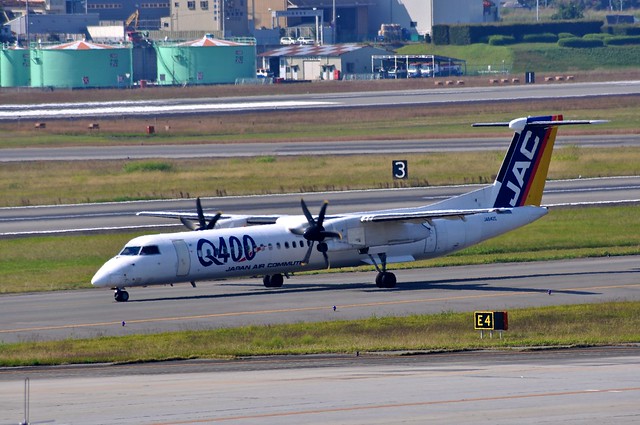
 In addition, there are black background with white letters signs for remaining runway distance, in units of 1000 feet. For example, the sign “3” at Osaka Airport below indicates that the remaining runway distance is 3000 feet when taxiing from left to right on the runway.
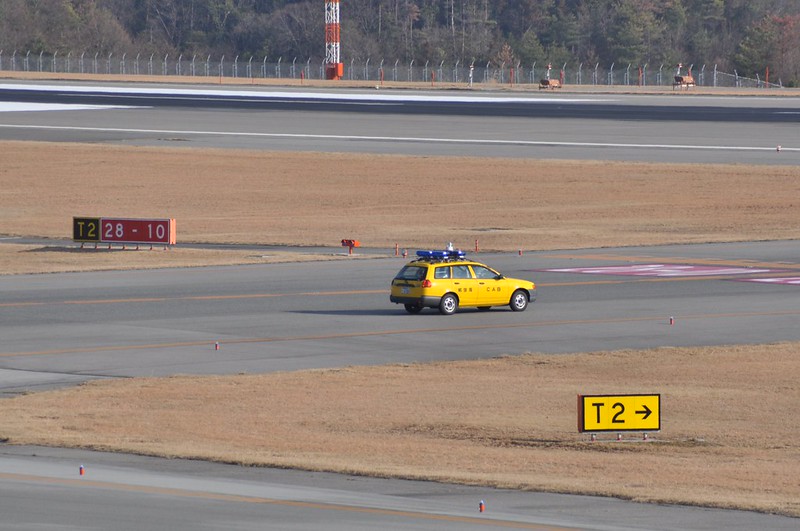
Let’s look at another example, taken at Hiroshima Airport. The sign in the front right corner indicates that turning right will enter point T2.
The sign in the rear left indicates that this location is point T2 and the runway 28-10 is imminent, so this point is the holding position for entering that runway.
The diagram below shows the layout of Haneda Airport, though this data is quite old. If you want to see the latest data, you can check it on OPENNAV website.
Additionally, this site has summarized a list of data for airports in China and Japan.
Feel free to refer to them.
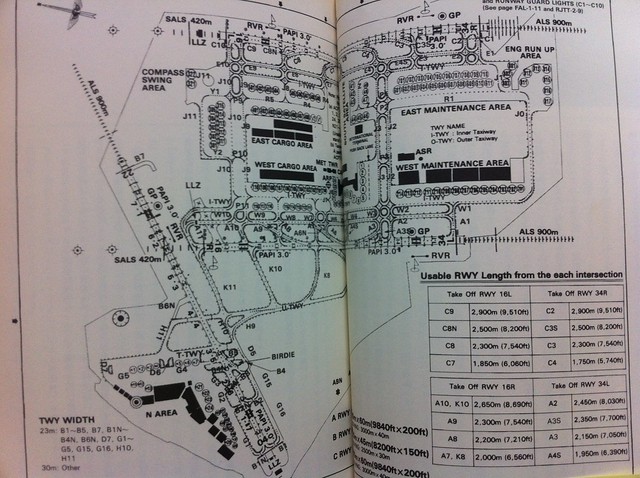 Enlarging the P3 J2 W2 part mentioned above here:
 Since the flight mentioned here was parked at Gate 2, after being pushed back it was near P3. So this route turns into the Taxiway from P3 first, passes J2 below to reach W2, and then continues all the way to the left to the end of Runway 16R.
Pilots must check both sides for safety through the windows to confirm absolutely no aircraft or ground vehicles are present before turning on the taxi lights on the nose landing gear, releasing the parking brake, lowering the Flaps to the takeoff position (5-10 degrees), and pushing the Thrust levers slightly forward (for a Boeing 777, maintaining the throttle at idle is sufficient). The engine speed increases, and the huge aircraft begins to move slowly. Once the aircraft starts taxiing, the pilots pull the throttle back to the idle position again.
Prev: Push Back from Gate and Engine Start TOC: Table of Contents Next: Operations During Taxi
End